Tuesday, November 12, 2013

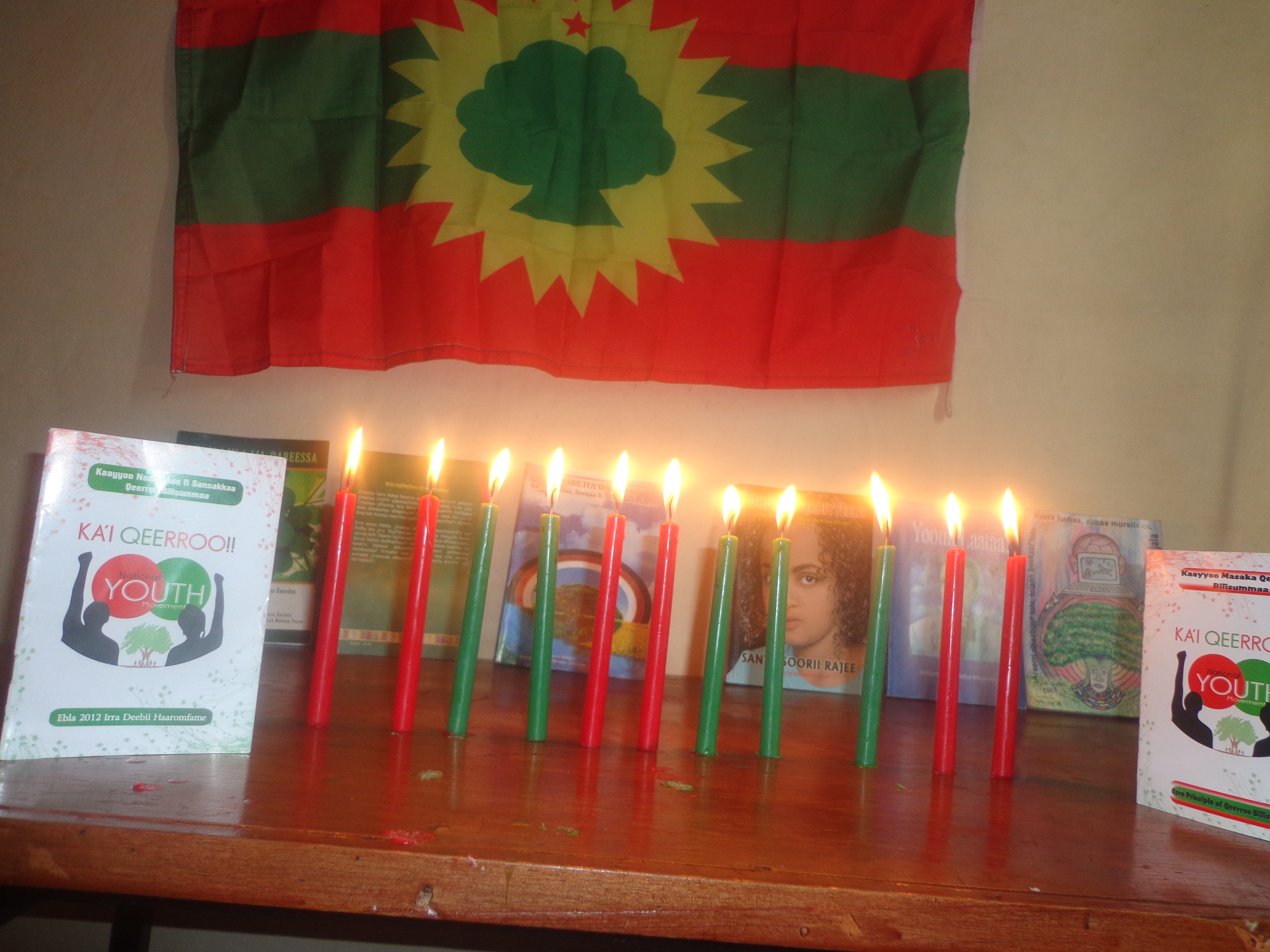
Sadaasa 9, Guyyaa FDG Ilaalchisee Ibsa Qeerroo Bilisummaa Oromoo


Finfinnee, Oromiyaa
Gabaasaa Galmee Sabboontota Oromoo Kanneen Bara Tokko Keessatti Hidhaman, Ajjeefamanii fi Bakka Buuteen Isaanii Dhabamee
(Sadaasa 2012 Irraa Hanga Sadaasa 2013)
Uummatni Oromoo sirna bittaa Wayyaaneef tole jedhee guyyaatti gabrummaa of irratti ilaale hin qabu. Uummanni Oromoo diddaa sirna cunqursaa kanaaf wareegama baroota 21 keessatti baase kan lakkaawamee dhumu miti. Oromiyaa keessatti sabboontota gaaffii mirgaa kaasan yeroo irraa yerootti mootummaa Wayyaaneen adamfamanii mana hidhaa adda addaa keessatti ugguramuun aadaa bulchiinsa EPRDF ta’uun beekama.
Bara tokkoo as Sadaasa 9, 2012 irraa eegalee hamma Sadaasa 9,2013 waggaa tokko keessatti sabboontotiin Oromoo FDG gaggeessaa jirtu jechuun mana hidhaatti ukkaamfaman lakkoofsaan hedduu ta’anis, gariis ajjeefamanii, gariin ammoo bakka buuteen isaanii dhabame. Walumaa gala Sadaasa 9/2012 irraa hanga sadaasa 9/2013tti FDG hedduun guutuu biyyaatti gaggeeffamaa bahe. Wayyaaneenis darara hidhaa fi ajjeechaa gaggeessaa ture. Bara kana keessa qabsoo bilisummaa Oromoof jechaa kanneen hidhaman, ajjeefaman yaadachuu fi sabni keenya adduunyaa irra jiru mirga qabsaawota kanaa bakka hundatti akka falmuuf jecha Sochiin Dargaggoota Oromoo Biyyoolessaa (Qeerroo Bilisummaa) galmee qabsaawota hidhamanii, ajjeefamanii fi bakka buuteen isaanii dhabamanii yeroo fi bakka irraa hidhaman waliin akka armaa gadiitti gabaasa.

Dokumenti Guutuu


Letter on Attach on Refugees and Laborers in Saudi Arabia

Mardaasa Addisu
Secretary of Macha Tulama
Cooperative and Development Association, USA
 November 12, 2013

Dear Prince Naif Ibn Abdul Aziz Al-Saud
Ministry of Interior
Kingdom of Saudi Arabia
Minister of Agriculture
Kingdom of Saudi Arabia
My name is Mardaasa Addisu My name is Mardaasa Addisu, an Oromo American, who is part of an international group advocating for Oromo rights. Oromo people are an ethnic group that makes up 50% of the population in Ethiopia but are being persecuted by the Tigrayan dictatorship. The Abyssinians (Tigray and Amhara) have committed Genocide on all Cushitic people to acquire resources and reduce the indigenous populations. As a result, Oromo (and all other Cushitic people) are displaced in mass numbers around the World.
More than 40% of Oromo are Muslim, with some seeking refugee in the Middle East, particularly Saudi Arabia. Many flee persecution in Ethiopia in hopes of finding refuge whereby they can practice their faith without Government interference. We are aware that a large number of people are also using the Ethiopian domestic labor agencies to reach Saudi Arabia.
Recently, Oromo advocates learned of your government ending the Kafala System of sponsorship for labor, which is believed to bypass Saudi Labor laws.
Human Rights Watch has been critical of the Kafala System in recent times stating:
“Saudi Arabia should get serious about regularizing the status of its workers and do away with an abusive labour systems that force migrants into illegal employment”
Although the changes are reform based, Saudi police are using brutal measures on foreign workers are severe human rights abuses, and are contrary to international norms. The deaths and attacks of laborers and refugees are direct human rights violations. It is also understood that many that are attacked are ether from East Africa or Asia.
Those from East Africa, particularly who have fled Ethiopia are primarily Oromo and or Ogadeni Somalia. Oromo and Ogadeni flee due to the overwhelming oppression in Ethiopia.
Oromo advocates are concerned with the planned deportation of Oromo and Ogaden refugees and laborers who fled from their countries in fear of persecution. While other countries can peacefully return their people to their native land, Oromo and Ogadeni run the risk of being thrown in jail in Ethiopia. Human Rights Watch documented Ethiopia’s prison abuses, particularly Oromo people in the following report:
–Full Letter in PDF

Ethiopians say: SomeoneTellSaudiArabia


Foreign workers leave the Manfuhah neighbourhood of the Saudi capital Riyadh on November 10, 2013, after two people were killed in clashes between Saudi and other foreign residents the previous day, according to the Saudi police. AFP/FAYEZ NURELDINE


Ethiopians online are condemning Saudi Arabia's crackdown on migrant workers after clashes between Saudi police and foreigners in southern Riyadh left at least two dead and many more injured. Policeidentified one of the dead as a Saudi national and did not identify the other victim. An Ethiopian man waskilled in a separate visa raid the previous week.
The clashes come during a visa crackdown on undocumented workers intended to reduce illegal sources of cheap labour and provide more jobs for Saudi nationals. Hundreds of thousands of foreign workers departed Saudi Arabia in the last seven months, during which they were required to resolve their visa status without penalty or leave the country. Police have arrested thousands since the amnesty period expired on November 4. 
 
The video below appears to show the clashes in the Manfuhah neighbourhood, with men in plain clothes beating and arresting others. The Stream cannot independently verify this video. 


Monday, November 11, 2013

Ethiopia’s Indigenous Excluded from Rapid Growth

By Ed McKenna

The ethnic communities living along Ethiopia’s Omo River and depend on annual flooding to practice flood retreat cultivation for their survival and livelihood. Credit: Ed McKenna/IPS

OMO VALLEY, Ethiopia, Nov 11 2013 (IPS) - As the construction of a major transmission line to export electricity generated from one of Ethiopia’s major hydropower projects gets underway, there are growing concerns that pastoralist communities living in the region are under threat.
The Gibe III dam, which will generate 1,800 megawatts (MW), is being built in southeast Ethiopia on the Omo River at a cost of 1.7 billion dollars. It is expected to earn the government over 400 million dollars annually from power exports. On completion in 2015 it will be the world’s fourth-largest dam.
"We are being told to stop moving with our cattle, to stop wearing our traditional dress and to sell our cattle. Cattle and movement is everything to the Mursi.” -- Mursi elder
But the dam is expected to debilitate the lives and livelihoods of hundreds of thousands of indigenous communities in Ethiopia’s Lower Omo Valley and those living around Kenya’s Lake Turkana who depend on the Omo River.
The Bodi, Daasanach, Kara, Mursi, Kwegu and Nyangatom ethnic communities who live along the Omo River depend on its annual flooding to practice flood-retreat cultivation for their survival and livelihoods.
But the semi-nomadic Mursi ethnic community are being resettled as part of the Ethiopian government’s villagisation programme to make room for a large sugar plantation, which will turn roaming pastoralists into sedentary farmers. The hundreds of kilometres of irrigation canals currently being dug to divert the Omo River’s waters to feed these large plantations will make it impossible for the indigenous communities to live as they have always done.
“We are being told that our land is private property. We are very worried about our survival as we are being forced to move where there is no water, grass or crops,” a Mursi community member told IPS.
The Omo Valley is set to become a powerhouse of large commercial farming irrigated by the Gibe III dam. To date 445,000 hectares have been allocated to Malaysian, Indian and other foreign companies to grow sugar, biofuels, cereals and other crops.
“The Gibe III will worsen poverty for the most vulnerable. The government already has trouble managing hunger and poverty [among] its citizenry. By taking over land and water resources in the Omo Valley, it is creating a new class of ‘internal refugees’ who will no longer be self-sufficient,” Lori Pottinger from environmental NGOInternational Rivers told IPS.
Top global financiers, including the World Bank and the African Development Bank (AfDB), have committed 1.2 billion dollars to a 1,070 km high-voltage line that will run from Wolayta-Sodo in Ethiopia to Suswa, 100 km northwest of the Kenyan capital, Nairobi. The transmission line, powered by Ethiopia’s Gibe III, will connect the country’s electrical grid with Kenya and will have a capacity to carry 2,000 MW between the two countries.
According to the AfDB, it will promote renewable power generation, regional cooperation, and will ensure access to reliable and affordable energy to around 870,000 households by 2018.
Although the latest U.N. Development Programme Human Development report ranks Ethiopia 173rd out of 187 countries, Ethiopia, Africa’s second-most populous country, is one of the continent’s fastest-growing economies.
According to Prime Minister Hailemariam Desalegn, Ethiopia’s economy is set to maintain a growth rate of 11 percent in 2014. Fully exploiting its massive water resources to generate a hydropower potential of up to 45,000 MW in order to sell surplus electricity to its neighbours is central to Ethiopia’s Growth and Transformation plan, a five-year plan to develop the country’s economy.
The Horn of Africa nation currently generates 2,000 MW from six hydroelectric dams and invests more of its resources in hydropower than any other country in Africa – one third of its total GNP of about 77 billion dollars.
According to a World Bank report published in 2010, only 17 percent of Ethiopia’s 84.7 million people had access to electricity at the time of the report. By 2018, 100 percent of the population will have access to power, according to state power provider Ethiopian Electric Power Corporation (EEPCO).
“We are helping mitigate climate risk of fossil fuel consumption and also reduce rampant deforestation rates in Ethiopia. Hydropower will benefit our development,” Miheret Debebe, chief executive officer of EEPCO, told IPS.
The Ethiopian government insists that the welfare of pastoralist communities being resettled is a priority and that they will benefit from developments in the Omo Valley. “We are working hard to safeguard them and help them to adapt to the changing conditions,” government spokesperson Shimeles Kemal told IPS.
However, there are concerns that ethnic groups like the Mursi are not being consulted about their changing future. “If we resist resettlement we will be arrested,” a Mursi elder told IPS.
“We fear for the future. Our way of life is under threat. We are being told to stop moving with our cattle, to stop wearing our traditional dress and to sell our cattle. Cattle and movement is everything to the Mursi.”
The importance of ensuring that benefits from Ethiopia’s national development projects do not come at a price of endangering the lives of hundreds of thousands pastoralist tribes is critical said Ben Braga, president of the World Water Council. Braga decried governments that failed to compensate communities like the Mursi as displacement of surrounding communities is always an inevitable consequence of major dams that need plenty of advanced planning to avoid emergencies.
“How can we compensate these people so that the majority of the country can benefit from electricity? There is a need for better compensatory mechanisms to ensure that benefits are shared and that all stakeholders are included in consultations prior to construction,” he told IPS.


Ethiopia summons Saudi Ambassador over killing and abuse

November 10, 2013 (ADDIS ABABA) – Ethiopia’s foreign ministry has summoned Saudi Arabia’s ambassador to Addis Ababa demanding explanation over the killing and ill-treatment of Ethiopian citizens in the gulf nation.

An Ethiopian national was killed this week by Saudi police in Riyadh as the Kingdom conducts a nationwide crackdown against illegal expatriates who most are from Africa and Asia.

Ethiopia has condemned the tough actions taken by the Saudi police.
"Ethiopia would like to express its respect for the decision of the Saudi Authorities and the policy of deporting illegal migrants. At the same time, it condemned the killing of an Ethiopian and mistreatment of its citizens residing in Saudi Arabia” said the ministry of foreign affairs in a statement it released on Saturday.

Following the incident, Ethiopia summoned the Saudi diplomat, Muhammed Ibrahim Alshugairan as a formal protest over the killing of its citizen who allegdly was killed for resisting arrest and trying to grab a police man’s gun.

Officials of the Ethiopia’s Ministry of Foreign Affairs have held discussions with the Saudi diplomat, Muhammed Ibrahim Alshugairan, over the issue and on ways how to jointly handle the situation with regard to Ethiopian migrants in Saudi.
Following the discussions, Alshugairan affirmed that he would address the issue to the Saudi government and promised to come up with an explanation soon.

Foreign ministry spokesman, Dina Mufti, said on Sunday that the Ethiopian government in collaboration with Ethiopian Embassy in Riyadh is working to safely repatriate thousands of its citizens who had failed to legalise their refugee status under the deadline of a seven-month amnesty.

Addis Ababa said the government is closely following the condition of Ethiopian nationals in Saudi Arabia who are under strong pressure for deportation.

"The Ministry of Foreign Affairs has deployed extra staff to help in the legal work required by the Saudi Authorities and provide support for Ethiopian workers residing in Saudi Arabia with no work permits as well as assist Ethiopian migrants where required” said the spokesperson’s office.

Since Saudi Arabia began the crackdown against undocumented migrants on 4 November thousands are said to have been arrested.

Currently there are an estimated 40,000 Ethiopian immigrants in the Saudi Kingdom who lack the proper visas and work permits.
(ST)


Urgent !!! Urgent !! Assistance…

Abdulkadir Noor Gumi | Sadaasa 10, 2013
Namoota Su'ud Arabiyaa irraa baqatee gara biyyatti galaa jiran
Namoota Su’ud Arabiyaa irraa baqatee gara biyyatti galaa jiran
Ilmaan Oromoo biyyaa Awropaa fii Ameerikaa kan jiraattan, akkasuma kan Australia jiraattan hundii keesanuu , isaan  kanneen carraa jiruu argattanii biyyaa nagaa jiraattan hundii keesanuu, carraa argattanii  mirgi namummaa keesan isaniif  eeggamee jirru dirqama lammummaa kan Oromummaa akka baatan marii hatattamaa roorroo Obboleeyan kanneen Gabrummaa warra Itoophiyaa jalaa baqatanii lubbuu ofii baafachuufi biyya Saudi Arabiyaa, Masrii, South Africa , Kenyaa, Djaboutii, Somaliland, Yemen jiraatanratti  yeroo adda addaa rakkoon irraatti argamtee jirtuu tana Embasii biyyootaa kanaa kan akkaa Saudii Arabia, Kenyaa, Masrii kan biyyoota isan  keeysatti argamtan duratti hiriira bahuun  balaaleyfachuu fii lubbuu ilmaan Oromoo kan isaan jalatti baqatanii osoo jiranii ajjeechaa fii roorroo Nama suukanneeysitu Tana akka irraa gaafatamuu jiraatanii fii, haala fokkataa bineensummaa kana ilmaan Oromoorraa akka dhaaban gaafachuun  dirqama lammummaa Oromoo waan taheef Communitiin Oromoo biyyaa  alaa Jiraatan hundii akka hiriira akkasii qopheeysanii gaafatan , Oromoon Itoophiyaa miti ! Oromoon Biyyiti isaatii fii lammiin isaatiis Oromiyaa dha!nuu rakkoo qabnaa , rakkoo san nuuf baraa jechuudhaan akka namaa  keenna biyyaatti hindeebifneefi ammaas mirgii isaani akka eegaman.
Abdulkadir Noor Gumi

Sadaasi 9, Yaadatnoon FDG Yuuniversitii Finfinnee fi Ambo Keessatti Bifa Addaan Kabajame.

Sadaasa 10,2013 Gabaasa QB Finfinnee 

DSC01251Sadaasa 9 Guyyaa Yaadannoo FDG hundeeffamma yeroo 8ffa Oromiyaa bakka adda addaatti kabajame oolera. Madda gabaasaa adda addaa Yuuniversitiiwwan irraa nugahan walitti qabaadhaan kan dhiyaatu yuuniversitii Finfinnee fi Yuuniversitii Amboo irratti guyyaan haraa guyyaa itti barataan Oromoo qabsoodhaaf waamicha waliif godhee jiruudha. Kunis yaadannoo yeroo 8ffaa FDG gaggeeffame mootummaa abbaa irree umurii isaa guutuu uummata biyyattii addatti uummata Oromoo garboomsee jiraachuuf akeekkatee jiru dura dhaabbachuuf buuureffame yoo tahu,kana yaadachuudhaan gabaasota guyyaa haraa Sadaasa 9 kabajamee oole irraa dhiyaatu wal duraa duubaan:
1. Yuuniversitii Finfinnee irratti-yuuniversitii kiiloo4, 5 fi 6 bakka tokkotti walitti dhufuudhaan guyyaa guutuu kabajaa kana irratti kan hirmaataniidha. Hirmaattootni Sadaasa 9 ilaalchisee guyyaa yaadannoo FDG kana irratti argaman barataa,barsiisaa fi hojjetoota garagaraa yuuniversitii keessaa hojjetan nuufis yaadannoodha jedhanii yeroo jalqabaaf kan irratti hirmaatanis kan jiraniidha. Walii galatti guyyaa yaadannoo kana irratti kan argaman namoota hanga 242 kan taaniidha. Guyyaa kana ibsoota.waadaa qabsootti hiriiruu fi mootummaa abba ahirree dura dhaabbachuuf yeroo itti murteeffannaadhaan kanneen irratti argamaniidha.
Gutummaan Gabaasa Yuuniversitii Finfinnee fi Aboo kanatti hidhatee jira:- FDG Sadaasa 9.docx