Sunday, June 8, 2014

Ethiopia Recruits Bloggers to Attack Oppositions and the Eritrean Government

Regime in Paranoia? From Jamming sattelite trasmissions, blocking websites, criminalise using Skype and arresting bloggers to recruting paid online attackers and arresting bloggers to training paid social media recruits?
Regime in Paranoia? From Jamming satellite transmissions, blocking websites, criminalise using Skype and arresting bloggers to recruiting paid online attackers and arresting bloggers to training paid social media recruits?
IN an attempt to reduce online criticisms and shower positive image of itself, the Ethiopian Government recently started to train and recruit paid attackers on the web to anything critical of its administration, the Ethiopian Satellite Television Service (ESAT) reported.
In the the second round of new recruits, 235 bloggers were trained in Adama town, focusing on how to shape public opinion on Facebook and other social media technologies by posting comments and documents that support the regime.
The training was given to selected people from different ethnic groups who support the regime, and that the trainees report directly to government officials, ESAT said.
So far, the trainees have opened 2,350 Facebook, Twitter and blog accounts to show the Ethiopian regime in a favorable light, and to criticize anti-government articles, websites, the Ethiopian opposition and the Eritrean government.
With a dismal one percent of people having access to the internet in Ethiopia, the likely intended target of the regime’s online strategy are the Ethiopian and Eritrean Diasporas, an observer noted.

Saturday, June 7, 2014

THE TORTURE AND BRUTAL MURDER OF ALSAN HASSEN BY ETHIOPIAN POLICE WILL SHOCK YOUR CONSCIENCE

alsanHassan(OPride) A 21-year old Oromo student, Nuredin Hasen, who was abducted from Haromaya University late last month and held incommunicado at undisclosed location, died earlier this month from a brutal torture he endured while in police custody, family sources said.

Members of the federal and Oromia state police nubbed Hassen (who is also known by Alsan Hassen) and 12 other students on May 27 in a renewed crackdown on Oromo students. Friends were not told the reason for the arrests nor where the detainees were taken.
Born and raised in Bakko Tibbe district of West Shawa zone, Alsan, who lost both of his parents at a young age, was raised by his grandmother.
The harrowing circumstances of his death should shock everyone's conscience. But it also underscores the inhumane and cruel treatment of Oromo activists by Ethiopian security forces.
According to family sources, on June 1, a police officer in Dire Dawa called his counterpart at West Shewa Zone Police Bureau in Ambo and informed him that Alsan “killed himself” while in prison. The officer requested the local police to tell Alsan's family to pick up his body from Menelik Hospital in Addis Ababa, Ethiopia's capital.
The West Shewa zone police relayed the message to the district police station in Bakko Tibbe and the latter delivered the message to Alsan’s family. Three family members then rushed to the capital to collect the corpse of a bright young man they had sent off, far from home, so that he can get a decent shot at college education.
Upon arrival, the hospital staff told the family to search for his body from among 30 to 40 corpse’s kept in a large room. According to our sources, what they saw next was beyond the realm of anyone's imagination. The details are too gruesome to even describe.
They found their beloved son badly tortured, his face disfigured and barely recognizable. His throat was slit leaving only the muscles and bones at the back of his neck connecting his head to the rest of the body. There were large cuts along his eyelids, right below the eyebrows as if someone had tried to remove his eyes. There were multiple wounds all over his face and head. Both of his arms were broken between his wrists and his elbows.
It appeared as if the federal forces employed all forms of inhumane torture tactics, leaving parts of his body severely damaged and disjointed. The family could not grasp the cruelty of the mutilation carried upon an innocent college student.
Their ordeal to recover Alsan's body did not end there either. Once the body was identified, the federal police officer who brought the body from Harar told the family to pay 10,000 birr (roughly $500) to cover the cost of transportation the government incurred. They were informed that the body will not be released unless the money is paid in full.
The family did not have the money, nor were they prepared for the unexpected tragedy. After friends and relatives raised the requested sum to cover his torturers costs, Alsan's body was transported to Bakko Tibbe, where he was laid to rest on June 2. There was little doubt that Alsan was murdered while in detention, but in police state Ethiopia, the family may never even know the full details of what happened to their son, much less seek justice.
In an increasingly repressive Ethiopian state, being an Oromo itself is in essence becoming a crime. To say the gruesome circumstances surrounding Alsan's death is heart-wrenching is a gross understatement. But Alsan's story is not atypical. It epitomizes the sheer brutality that many Oromo activists endure in Ethiopia today.
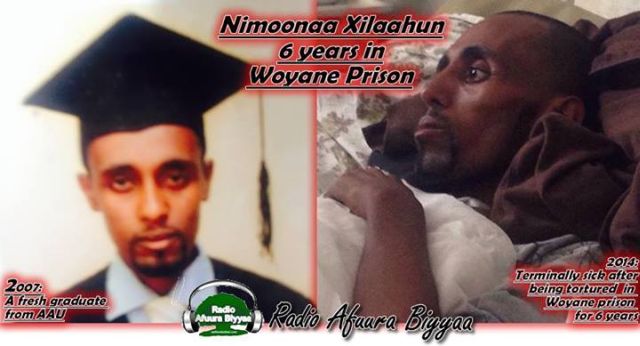
NimonaTilahunOn June 6, another Oromo political prisoner, Nimona Tilahun passed away in police custody. Tilahun, a graduate of Addis Ababa University and former high school teacher, was initially arrested in 2004 along with members of the Macha Tulama Association during widespread protests opposing the relocation of Oromia's seat to Adama. He was released after a year of incarceration and returned to complete his studies, according to reports by Canada-based Radio Afurra Biyya.
Born in 1982, Tilahun was re-arrested in 2011 from his teaching job in Shano, a town in north Shewa about 80kms from Addis Ababa. He was briefly held at Maekelawi prison, known for torturing inmates and denying legal counsel to prisoners. And later transferred between Kaliti, Kilinto and Zuway where he was continuously tortured over the last three years. Tilahun was denied medical treatment despite being terminally ill. His death this week at Black Lion Hospital is the third such known case in the last two years.
On August 23, 2013, a former UNHCR recognized refugee, engineer Tesfahun Chemeda also died  under suspicious circumstances, after being refused medical treatment. In January, a former parliamentary candidate with the opposition Oromo People's Congress from Calanqo, Ahmed Nejash, died of torture while in custody. These are the few names and stories that have been reported. Ethiopia holds an estimated 20 to 30 thousand Oromo political prisoners. Many have been there for more than two decades, and for some of them not even family members know if they are still alive.
While Alsan, Chemeda, Nejash and Tilahun's stories offer a glimpse of the brutality behind Ethiopia's gulags, it is important to remember thousands more face similar heinous abuses everyday.
Since Oromo students began protesting against Addis Ababa's unconstitutional expansion in April, according to eyewitnesses, more than a 100 people have been killed, hundreds wounded and many more unlawfully detained. While a relative calm has returned to university campuses, small-scale peaceful protests continue in many parts of Oromia. Reports are emerging that mass arrests and extrajudicial killings of university students are far more widespread than previously reported. Last month, dozens of students at Jimma, Madawalabu, Adama and Wallaggauniversities were indefinitely dismissed from their education. In addition, an unknown number of students from all Oromia-based colleges are in hiding fearing for their safety if they returned to the schools.
Given the Horn of Africa nation's tight-grip on free press and restrictions on human rights monitoring, in the short run, the Ethiopian security forces will continue to commit egregious crimes with impunity. But the status quo is increasingly tenable. For every Alsan and Tilahun they murder, many more will be at the ready to fight for the cause on which they were martyred. As long repression continues unabated, the struggle for justice and freedom will only be intensified. No amount of torture and inhumane treatment can extinguish the fire that has been sparked.
*The writer, Amane Badhasso, is the president of International Oromo Youth Association, and a political science and legal studies major at Hamline University. Badhatu Ayana is an Oromo rights activist.

Waxabajjii 20, 2014: Waamicha Hiriira Mormii Haawaasa Oromoo Awroopaa Maraaf Brussels

Gadaa.com
Waa’ee Qotee bultoota Oromoo handhuura Oromiyaa irra buqqisuu, qabeenya isa saamuu, ajechaa fi hidhaa barattoota Oromoo irra gahaa jiru mormachuuf jecha, hawaasotni Oromooo biyyoota Awuroppaa jirru gamtaadhaan Hiriira Mormii bahuuf murteesinee jirra.
Haaluma kanaan, qaamotni dhimmi kun nu ilaala jettan hundi yeroo murtessaa kanatti hiriira mormii gamtaa kana irratti argamuun aantummaa saba keessanii akka agarsiiftan kabajaan gaafanna.
Arihatama, saamichaa fi ajechaa sukanessaa saba Oromoo irra gahaa jiru handhuura Awuroppaa kana taate Belgium, magaala Brussels ti argamuun Parlamaa fi angawoota kanatti akka iyyannu karoorfamera.
Kotta saba keenyaaf sagalee haa taanu !!!
Guyyaa: Waxabajjii 20, 2014 (Jimaata) ykn (Friday, June 20, 2014)
Sa’aa: 10:00–13:00
Bakka ka’umsaa: Parlamaa Awuroppa Fuldura
European Parliament, Leopold park
Belliardstraat 125, 1000 Brussels
Koree Qiindesitu Hiriira Mormii Hawaasa Oromoo Awuropaa
Brussels, Belgium
Email: oromoeuprotest@gmail.com

Twitter: @oromoeuprotest
Mobile:
+32 489 367 123 – Mootummaa
+32 466 418 066 – Solan
Tokkummaan Humna!

Ethiopia: Has the Government suspended Mayor of Addis Ababa?

Khartoum (HAN) June 6, 2014. Ethiopian News Opinion By, MINILIK SALSAWI, Breaking News. Abadula Kuma Mayor of Addis Ababa has suspended from any type of activities, Stripped-off their passport and fall under 24 hours surveillance. the ruling party took such radical measure and start to swallow even his own loyalists following the dispute of Adis Ababa master plane expansions. No one knows where to end perhaps it may go further down to the grassroots level. Eradicate all the Network planted by Abadulla and his compatriots for the past two decades is not going to be an easy task with out that “evil genius” who used to manipulate the balance power.
“Those who make peaceful evolution impossible will make violent revolution inevitable” ~John F. Kennedy

The Tigray ruling party tplf  of 6% that controls over 98% of the military leadership of some of the 90 million Ethiopians from the time it arrived to addis as well as using divide and rule tactics of survival of the minority over the majority will now engage in mobilizing Amhara patriots from corner to corner against Oromos.
That is for the purpose of weakening the Oromo people’s rights, in general as well as in the coming 2015 make believe one party election acrobat, while currently Amara patriots are gleeful and too much over glad, just similar to the bygone time in 2005 election period when the tplf banished Oromia administration office form Addis Ababa to Adama to clear the ground for CUD’s land slide victory that almost swallowed the tplf and its leader from existence on spot, but again now Amara patriots saying “what goes round, comes round” to oromos while they themselves are now living the flowery days in their ususal opinion while waiting for the right occasion and for their turn to be an object of  TPLF’s devious attack that is sure to happen just when the current dust concerning the Addis plan settles down and the Amara jubilation slowly but surely cools down to realities.
Oromo people are asking themselves, Why Oromo region is under military rule?


General Samora Muhammad Yunis said the military ae in Oromo regional state specific area because “of the violence in Bangkok and many parts of the country that resulted in loss of innocent lives and property, [which] was likely to escalate”.
General added: “We ask the Ethiopian public not to panic and to carry on their lives normally.”
A curfew has just been declared some parts of Oromia, so the Ethiopian military is obviously making efforts to make sure there is no immediate response to its announcement.


Friday, June 6, 2014

Nimoonaa Tilahuun wareegame

(Oromedia, 6 Waxabajjii 2014) Mana hidhaa mootummaa Itoophiyaa keessatti waggoota dheeraaf dararamaa kan ture, sabboonaa Oromoo, Nimoonaa Tilahuun guyyaa har’aa addunyaa kana irraa boqote.
Nimoonaa Xilahuun
Nimoonaa Xilahuun
Sababa gaaffii mirgaa fi bilisummaa Oromoo deeggareef humnoota tikaa wayyaaneetiin Waxibajjii 26, 2008 hidhattoota mootummaa konkolaataa gabatee isaa 3-F ta’een qabamee kan hidhame Nimoonaa Xilahuun, manneen qorannoo fi hidhaa Itoophiyaa kan akka Maa’ikalaawwii fi Qaallittii keessatti hiraarfamaa akka ture ni beekama.
“Namni mul’ataa jabaa qabu kun hojii barsiisummaa jalqabee otuu baatii tokko hin gahiin Poolisii Federaalaatiin ukkaamfame,” kan jedhan hiriyooti isaa yeroo sanatti ijaan argan, “Konkolaataa kana keessaa namootni uffata sivilii uffatan utaalanii bu’uudhaan balleessaa tokko malee barsiisaa Nimoonaa ukkamsanii fuudhanii sokkan,” jedhan.
Hiraarfama waggoottaan dheeraatiin dhukkubsatee wal’aansa gahaa dhabee kan ture sabboonaan Oromoo kun, yeroo sana irraa kaasee haga dhiyeenya kanaatti tajaajila gahaa dhabuu irraa kan ka’e hedduu hubamuu isaa ibsan.
“Woggootii ja’aan darbaniif Manneetii hidhaa Mayikelaawwii, Qaallittii, Qiliinxoo, akkasumas Ziwaayitti gidiraa ilmoon namaa arguu hinqabne baayee arge,” kan jedhan raga-baatoti kunneen sababa kana irraa kan ka’es dhukkuba irra bu’uu isaa mirkaneessan.
Yeroo hedduu erga hubamee booda akka yaalamuuf gara hospitaala Xiqur Anbassaa geessamus, qaamni isaa hubame deebi’ee dandamachuu waan dadhabeef du’a irraa hafuu hin dandeenya.
Nimoonaa Xilahuun sabboonaa, kutataa fi qaroo dhimma sabaa irratti ejjannoo jabaa qabu ta’uu hiriyooti isaa ragaa bahu.
Nimoonaa June120142Hiriyooti isaa akka ibsanitti, Nimoonaan akkuma maqaa isaa, yeroo  mana barumsaa ture irraa kaasee haga gaafa hidhameetti, otuu garbummaa fi garboonfataaf hin jilbeeffatiin nama kutannoon qabsaa’aa  tureedha.
Mana hidha akeessattis doorsissaa fi reebicha diinaaf otuu hin jilbeeffatne, ejjannoo isaatiin waan dhaabbateef murtiin guddaa itti darbee ture.
Seenaa isaa irraa akka hubatamutti, Nimoonaa Xilaahun bara 2007 Yunversiitii Finfinneetii eebbifamee godina Shawaa Kaabaa  mana barumsaa Shanootti barsiisaa ta’ee ramadame. Waxabajjii 26, bara 2008 immoo humnoota tikaatiin ukkaamfamee woggootii ja’aan darbaniif Manneetii hidhaa Mayikelaawwii, Qaallittii, Qiliinxoo, akkasumas Ziwaay keessatti gidiraa ilmoon namaa arguu hinqabne baayee argaa ture.
Dhukkuba isaa kanaafis yeroo dheeraa fuundura woldhaansa haakimaa argachuun irra ture hinargatiin hafe. Bulchiinsi mana hidhaa lubbuu dargaggoo kanaa baraaruuf gargaarsi woldhaansaa hakimaa olaanaan akka isa barbaachisu otuu beekanii yeroo dheeraadhaaf wal’aansa ugguran.
Dhuma irratti guyyaa muraasa fuudura waardiyyoota poolisii federaalaa afuriin marfamee eegamaa hospitaala Xiqur Anbessaa akka seenu godhan. Haata’uutii, qaamni isa adhukkubaan hubame dandamachuu wana dadhabeef hospitaala “yaalamaa” ture keessatti waxabajjii 6, bara 20014 ganama addunyaa kana irraa darbe.
Nimoonaan akkuma sabboontota Oromoo, sababa garbummaa didee bilisummaa filateef hidhaatti darbame;  mana hidhaa dararamaa ture keessatti lubbuu isaa jijjiirraa hin qabne bilisummaa Oromoof wareege.
Oromedian maatii isaatiif jajjabina; lubbuu isaaf immoo qabbana hawwa.

Eutelsat Fingers Ethiopia as Jamming Incidents Triple

By Peter B. de Selding 


PARIS — Satellite fleet operator Eutelsat said intentional interference, which accounted for just 5 percent of the disruptions to its fleet in 2010, was responsible for 15 percent of the signal disruptions in 2013.
The tripling of intentional interference events, tied in part to the expansion of Eutelsat’s fleet serving Middle Eastern and African television audiences, is unlikely to drop in 2014 with the latest round of jamming by an unidentified source in Ethiopia.
Eutelsat said the jamming, which has affected Riyadh, Saudi Arabia-based Arabsat’s satellites as well as at least two Eutelsat spacecraft, has been geolocated in northeast Ethiopia.
The way the jamming is conducted has resulted to interference not only on the presumed target broadcaster, but to all broadcasters sharing the affected satellite transponders.
Jean-Francois Bureau, director of international affairs at Paris-based Eutelsat, said the company has relayed its jamming data to the French National Frequencies Agency (ANF), which will forward it both to the International Telecommunication Union (ITU) in Geneva and to the Ethiopian government as part of a protest.
Arabsat has similarly said it is taking its protest to the ITU, although industry officials admit the United Nations affiliate has no real power to impose penalties on governments, even those that are identified as conducting or sanctioning the interruption of satellite signals.
Alexandre Vallet, head of regulatory affairs and spectrum and orbit resources at the French ANF, said France will be working within the ITU this year to push forward an ITU proposal to use a global network of antennas to geolocate jamming sources more quickly.
Satellite operators, especially those that have joined the Space Data Association and are contributing to a data pool at that organization, already are able to use each other’s satellites to identify, with a precision to within 100 kilometers — and usually much less — a source of jamming.
Mark Rawlins, head of payload operations and engineering at Eutelsat, said June 4 that it took Eutelsat just a couple of hours, using two of its own satellite located near each other, to pinpoint the Ethiopian jamming source.
Rawlins said the jamming source is using a high-powered antenna to disrupt programming on the uplink to transponders on two Eutelsat satellites, located at 7 degrees west and 21 degrees east.
Rawlins declined to speculate on the reason for the jamming, saying jammer motivations, while usually political in nature, are not always easy to discern.
The Eutelsat spacecraft affected carry a channel owned by Oromia Media Network of Minneapolis, a network that has been jammed before. The network launched in March to provide independent, citizen-driven reporting on Ethiopia and Oromia, the country’s largest and most populous state.
“We believe this is part of the Ethiopian government’s  [policy of] silencing alternative voices,” the network said in a June 5 statement, citing previous examples of Ethiopian government officials’ defense of jamming techniques.
Arabsat does not carry Oromia broadcasts, but one industry official speculated that the jammers are aware that Arabsat may soon sign a contract that would put Oromia on an Arabsat satellite at 26 degrees east.
While Eutelsat and Arabsat both say they have localized, beyond a reasonable doubt, the national territory in which the jamming is occurring, their claims as interested parties do not carry the weight of a neutral oversight network.
That is why France and other nations are backing the ITU proposal to create a network of antennas recognized by the ITU has being objective.
“Our understanding is that the proposed contributors to the network have agreed to participate, and what we want to do now is close the loop with the ITU,” Vallet said here June 2 during the Global Space Applications Conference, organized by the International Astronautical Federation.
Lyudmyla Karpenko, of the Ukraine State Center of Radio Frequencies, said a Ukrainian antenna farm near Kiev is one of the proposed contributors to the ITU network and has agreed to take part.
Most satellite signal interference events are due to poorly aimed or maintained ground antennas that accidentally cause interference. The Space Data Association and other industry organizations, including the Global VSAT Forum and the Satellite Interference Reduction Group — backed by industry heavyweights including fleet operators Intelsat, SES, Inmarsat and Eutelsat — are promoting ways to stop accidental interference.
The methods include systematic training of ground operations and the adoption of “Carrier ID” by satellite antenna manufacturers enabling quick identification of antennas that are causing interference.
But Carrier ID will not resolve the problem of intentional jamming, which in Eutelsat’s case has reached about 15 percent of total annual interference events. Bureau said part of the reason for the increase is that Eutelsat’s fleet has increased from 28 satellites to 34 in the past three years, meaning the company is now a larger target in interference-prone zones.
“What is clear is that over the past three years there has been a significant increase in deliberate jamming,” Bureau told the conference.
Vallet said that given the lack of enforcement muscle at ITU, the best way to combat jamming for now is “naming and shaming” the perpetrators and using diplomatic pressure to get them to stop.
Rawlins said the SDA grouping of satellite operators — to date, Asian operators have not been persuaded to join the group — is working on automating their geolocalization so that they interconnect automatically. The new system should be operational by early 2015.

OromoProtests in Perspective

By Ayantu Tibeso

Image via Twin Cities Daily Planet
June 6, 2014 (warscapes) – Since April 25th, thousands of high school and university students across Ethiopia’s largest region, Oromia, have turned out in peaceful protest against a government land grab that stands to displace millions of indigenous peoples from their ancestral lands. Even though the country’s constitution theoretically allows for peaceful demonstrations, the student protesters, along with local populations in many cities and towns, have faced a ruthless crackdown from Ethiopian Special Forces, known as the Agazi Commandos. These forces have used excessive violence by indiscriminately shooting into crowds in an attempt to quash the protests. Children as young as eleven years old have been killed, according to statement issued by Amnesty International on May 13, and reports of fatal injuries, torture, imprisonment, disappearances and killings have been coming out of Ethiopia since then.
The Ethiopian government has evicted millions of indigenous peoples from their homelands at gunpoint under the pretext of “development” since it took power. In and around the capital of the country, Addis Ababa, over 200,000 of these residents have been removed from their lands without proper compensation since 2005. The newly-announced Integrated Development Master Plan for Addis Ababa (known simply as the “Master Plan”) seeks to legalize past land grab activities and to consolidate larger areas of territory displacing native peoples from their land. The Master Plan will expand the territory of Addis Ababa city administration to about 25 times its current size and is expected to forcefully remove another four to five million Oromo peasants from their lands within the coming years.
The current Ethiopian government came to power in 1991. It is a government dominated mainly by elites from a single ethnic group, the Tigray, which constitute approximately six percent of the peoples within Ethiopian boundaries. The Oromo, who are targeted by this Master Plan, make up between 40-50 percent of the population.  The Ethiopian Agazi special Commando force is almost entirely Tigrayan. The government relies on this ethnic army to stamp out the Oromo protests.
The current crisis cannot be understood apart from the ethnic dynamics at play in the policy of the Master Plan and in its response.  In the Ethiopian political, social and economic system, ethnicity and language are the two most important factors which influence policy preferences and choices of different sectors or communities in Ethiopia.  It is also along these two dimensions that the Ethiopian state has been structured since the current regime came to power. In recognition of these factors, a formal system of Ethnic Federalism has been instituted and written into law as the centerpiece of the Constitution of the Federal Democratic Republic of Ethiopia. Oromia, where most Oromos reside, is legally recognized as one of the nine members of the Ethiopian Federation.
In practice, however, all the key government positions and institutions are controlled by elites—directly and indirectly—that come from the Tigrayan ethnic group. Key positions in security sectors, including the military, are exclusively under the control of Tigrayan rulers. It is this group of elites that have aggressively pursued policies that have drawn on the military might to remove Oromo peasants involuntarily from their homeland over the last decade or more. The new Master Plan for Addis Ababa should be seen in this context, as the protestors well understand.  The Master Plan is one more chapter in implementing a disastrous policy that has already displaced thousands of the native peasants, and now officially aims to displace millions more. This is the policy against which Oromo students have gone out to protest. In keeping with their former legacy of sheer brutality, the Tigrayan ethnic armed force, the Agazi, responded to peaceful gatherings with a rain of bullets.
The brutal crackdown on the Oromo people is not new. The Ethiopian state itself has been predicated upon the expropriation of Oromo lands and held together through violent assimilationist policies, the destruction of the identity of conquered and resistant people, and economic and political exploitation of groups who are not represented in government. With each changing regime state power has been retained in the hands of minority rulers and the Oromos, who are the largest group living on the richest land, have remained the main targets of Ethiopian state repression, terrorism and discrimination. Over the last two decades alone multiple human rights organizations have released reports documenting the extent of extrajudicial killings, mass imprisonment, and torture on a massive scale, mutilations and disappearances. For instance, as of May 2012, the Oromia Support Group reported 4,407 extra-judicial killings and 992 disappearances of civilians perceived to support the political and even social groups opposing the current regime. Most of these have been Oromo people.
It is within this context that the current violent response to Oromo protests should be understood and appreciated. Like it has always been, kidnappings and/or extrajudicial killings, arbitrary arrests and disappearances continue in different parts of Oromia Regional State. Those being imprisoned face an imminent danger of death, torture or disappearance.  Yet despite the fact that the situation is quickly deteriorating, it is going largely unreported in the international media. The Ethiopian government is notorious for keeping very tight control over all local and international media in the country. Information is not easily attainable. Independent journalism and human rights monitoring are securitized and criminalized. Major restrictions remain on exchange of information, as the government is known to block almost all websites it regards as forums capable of providing information about the atrocities committed by its security agents. These include all independent websites that are situated both in and outside of Ethiopian territories. Given these circumstances, it has not been possible to determine the exact number of victims of the recent retaliation against Oromo protesters.  But thanks to social media and mobile technology, a view of the scale of the crisis is emerging.
Some human rights organizations have managed to get limited information and offer an insight regarding what is taking place as the protests continue. For instance, according to the above-mentioned statement released by Amnesty International, hundreds of those arrested during the protests have been held at different detention centers, including at unauthorized places such as police and military training camps. Detention in these places is almost always arbitrary, with prisoners spending months and years without being formally charged or taken to a courtroom. As the Amnesty International report notes, “military camps in Oromia have regularly been used to detain thousands of actual or perceived government opponents.” These detainees are not allowed access to lawyers or relatives, usually throughout the duration of their detention. In many instances, relatives do not know where their loved ones have been taken upon arrest. Human rights organizations, including Amnesty International have received reports of torture on a massive scale at these unofficial holding places.
In addition to Amnesty International, other human rights organizations have also released statements of concern that recent detainees face imminent risk of torture and abuse, if not death. Human Rights Watch reported that security forces beat and shot at peaceful Oromo protesters in many towns in Oromia Regional State, among others, Ambo, Nekemte, Gimbi and Jimma. The Human Rights League of Horn of Africa has also issued a report citing torture and disappearances in places where student protesters are being held in Naqamte, East Wollega zone. In one instance alone, fifty detainees were taken away by security forces in Naqamte.  Their whereabouts remain unknown.
The crisis in Ethiopia is a major international story of mass protest, wholesale dispossession of millions of peasants, and state-sponsored violence.  Yet it has gone almost completely ignored in the international media. To be sure, the story has attracted fleeting attention from English-language outlets like the BBC and the Guardian, while Al-Jazeera has curated what little information trickles out of the country from social media users on the ground.  But sustained analysis of the causes and context of the government’s plan, the protests in response and the violent government crackdown have been hard to come by.
There are a number of reasons the story hasn’t grabbed attention around the world—the situation’s complexity, the tight control of information by Ethiopian authorities, and western journalists’ unfamiliarity with Ethiopia’s tense ethnic politics, to name just a few. But the bigger issue has to do with Western media bias. Over the years, a considerable amount of attention has rightly been given to bloggers and journalists whose individual rights have been violated by the Ethiopian government. This is not surprising. It is easy to sympathize with those trying to practice their freedom of expression or tell a difficult story in the face of authoritarianism. The repression of media in a given country is an easier account to give, and it is a simpler story to process. The miseries and violence of the other repression—that against the voiceless masses—cannot afford to be get lost in the shuffle, as the situation in Oromia makes clear.   As long as this bias remains salient, the deaths of hundreds, possibly thousands, will continue to go unreported and unrecognized, and the cause for which so many have sacrificed will remain hidden.
Ayantu Tibeso is a researcher and communications consultant based in North America. She can be reached at atibeso@gmail.com or on twitter @diasporiclife.