Sunday, November 22, 2015

These African 'countries' don’t officially exist - including one that you've probably never heard of


Post-colonial African liberation movements you might not have heard too much about, and why owners like Angola, Zambia and Namibia won't 'let go'.


ANGOLA marked its 40th birthday this month and while the south African country blew off the candles, there’s one situation it would be happy the world didn’t pay much attention to.
The “Republic” of Cabinda has even set up its own de facto government, but Angola has no doubt about who the area falls under, having steadfastly held that it is sovereign territory administered from Luanda.
The geography, and history, however stokes the debate: not only is the area completely separated from Angola by a narrow strip of territory belonging to the Democratic Republic of the Congo, but it was also only a protectorate of the Portuguese (called Portuguese Congo) and was only formally integrated into Portuguese Angola in the 1950s. In 1963, the Organisation for African Unity - now the African Union - recognised the distinction between Angola and Cabinda by ranking Cabinda as the 39th state. Internationally though, the area is recognised as part of Angola.
Following independence from the Portuguese, the self-determination movements in Cabinda carried on in the activities of FLEC (Front for the Liberation of the Enclave of Cabinda), this time against their African colonisers. The Cabinda people have not given up, even though the region has now become the country’s most militarised area as a way of control. FLEC continues to carry out a low-level insurgency in the area, with sporadic attacks on army patrols and oil workers - one high profile attack included a bus carrying the Togolese football team in 2010. 
So why won’t Angola let go? Though Cabinda represents just a tiny part of Angola’s overall territory - it’s about the same size as The Gambia - it holds vital economic importance to the country producing most of Angola’s oil wealth - up to 70%—and therefore the revenue on which the government survives. 
Cabinda is not alone. Across Africa there are areas which have famously called for secession such as Western Sahara, Somaliland and Puntland - functioning with their own governments and in some cases getting increased international recognition, but there are still others which fly low below the radar…where their “African masters” like to keep them: 
Barotseland
The people and royal household of Barotseland, in western Zambia, have been agitating for the region’s independence. They accuse the Zambian government of ignoring a 1964 treaty which established Barotseland’s position within Zambia as an autonomous region, in place of the earlier agreement between Barotseland and the British Government. 
Barotseland, the kingdom of the Lozi people ruled by the Litunga (king or paramount chief), was a protectorate under British colonial rule and became part of Zambia at the country’s independence in 1964. In 2012, a group of traditional Lozi leaders, calling itself the Barotseland National Council, declared that Barotseland was now free to pursue its own peaceful “self-determination and destiny.” 
Zambia was quick to quash these declarations and in December 2014 the administrator general of the Barotseland transitional government, Afumba Mombotwa, and three other secessionists were arrested for treason. If they are found guilty they will be hanged. Their trial, which began in August 2015 is still underway though petitions have been handed to the UN demanding the release of the political prisoners. 
So why won’t Zambia let go of the Kingdom? Barotseland is in the upper Zambezi valley which means it has very fertile land. The floodplain is also something of a tourist attraction but the main reason could be because the region has oil potential, in addition to other minerals. In 2011 the government awarded the first petroleum exploration licence to a Zambian company, Barotse Petroleum Company, to explore oil and gas in the province. 
Free Republic of Rehoboth
Chances are that you’ve not heard of this one. 
The Rehoboth Basters, descendants of Cape Colony Dutch settlers and African women, number about 35,000-55,000 people and live in an area of 14.216 sq.km south of Windhoek, the capital of Namibia. They claim they settled in the late 1860s and developed their own legislation, years before the Germans installed their colonial rule over Namibia in 1885, giving them a right to independence. 
With Namibia’s independence in 1990 they lost their status, which they have been demanding back. The United People`s Movement (UPM) was established in 2009 to unite the Baster People and provide them with a political voice, pushing for autonomy of their political affairs. 
However, in the case of the Basters, it’s not that the government doesn’t want to let the area go - they are simply not seen as being of consequence because of their small numbers. Their traditional authority is not being recognised anymore and the Namibian government has registered Rehoboth as commercial land.
Ogoniland
Under the Movement for the Survival of the Ogoni People (MOSOP), founded in 1990, the people of Ogoni are attempting to disengage from Nigeria having declared independence in 2012. They also presented a Bill of Rights to the Government of Nigeria calling for political control of Ogoni affairs by Ogoni people. It states that the Ogoni people seek, “political autonomy to participate in the affairs of the Republic as a distinct and separate unit (by whatever name called), provided that this autonomy guarantees political control of Ogoni affairs by Ogoni people”.
MOSOP claims that the Ogoni people’s independence was first violated by British colonialism and then “handed over to some other Nigerian ethnic groups in October 1960.” The problem is in 1957 Shell Oil Company struck oil in Ogoniland, which set in motion a process transformed both Ogoni society and Nigeria as a whole. Today, oil accounts for over 90% of Nigeria’s export earnings and some 80% of government revenue, controlling the entire Nigerian economy.
The independence movement is driven by the community feeling inadequately compensated for the take-over of their land by the oil companies and the environmental damages they suffered.
Nigeria has also seen activism around Biafra, for which hundreds of people marched this week, as marginalisation grievances swirl over an area that caused a major civil war in the 1960s.
Oromia
In Ethiopia the Oromo people -  the country’s largest community with 30 million members, constituting 34.49% of Ethiopia’s population - lay claim to the country of the Oromo, called Biyya-Oromo or Oromia. Oromia is described as one of the free nations in the Horn of Africa until its colonisation and occupation by Abyssinia at the end of the nineteenth century. Their self-determination movement is being pushed by the Oromo Liberation Front, or OLF, an organisation established in 1973. 
Their attempts for secession however are being fought by a central government that cannot afford to lose this bread basket, with human rights groups saying there have been excesses. Oromia is the region where coffee first originated, today it accounts for more than 65 % of the country’s total coffee growing land and coffee is the country’s largest export. 
Casamance
The Senegalese region has also since the 1980s waged low-level resistance over what it says is marginalisation. Successive peace deals have been signed, and the central government has pushed economic plans to stamp out the disquiet, which has been quiet for the last few years.


Saturday, November 21, 2015

KDF deployed at border after Ethiopian forces kill Kenya police

By ALLI ABDI and LIBAN GOLICHA

MARSABIT: The Kenya Defence Force (KDF) has moved its armoured vehicles and tanks from the Odha Military Camp in Moyale to Sololo following an invasion by Ethiopian forces who killed three police officers.

The development last evening follows a fierce gun battle earlier in the day between Kenya police and Ethiopian forces at Anona and parts of Sololo Township in Kenyan territory.  Marsabit County Police Commander Bernard Kogo said three Kenyan security officers were killed but declined to reveal the casualty on the Ethiopian side.  "We lost three officers at the border (Sololo) and I do not know what happened on their (Ethiopian) side,"  said Mr Kogo.

 On Thursday, a senior provincial administrator  identified a senior chief   who was gunned down by allegedly rebels from the Oromo Liberation Front (OLF). Ethiopia is fighting the rag-tag OLF rebels in Ethiopia and parts of Marsabit County that it claims hosts their rivals. 

OLF is opposed to Ethiopia's ruling regime and claims it has marginalised the majority of Oromia-speaking people who include the Borana, also found in Kenya. 

At dawn Friday, Ethiopian forces in full military attire invaded villages in Sololo District where locals led by area MP Roba Duba said at least 24 Kenyans were abducted.

 "Eleven people were rounded up and taken away by Ethiopian soldiers. Before that they beat up everyone in their sight with gun butts, kicks and blows,’’ said Adan Jirma, a resident of Sololo South.

At around midday Friday, Ethiopians soldiers made a second invasion in the two centres while backed by armoured vehicles.  This prompted administration and regular police, backed by Kenya police reservists, to engage the foreign army in a shootout.

As the gun battle between the two sides raged up to about 4pm Friday, KDF’s army multi-unit detachment from Odha in Moyale, about 100km away, rolled its armoured cars and tanks that were deployed at the border, stretching a distance of about 15km. 

Sololo OCPD Benjamin Mwanzia said the military had been deployed to guard against further incursion but declined to give details. 

 National Hospital Insurance Fund Chairman Mohamud Ali called on the Kenya Government to protest what he called frequent invasion by Ethiopian forces into Kenyan territory. "We are a sovereign state and this (invasion) is bad because Ethiopia is considered a friendly neighbour. It is high time our government sends a strong signal to them," said Ali. Mid this year, Ethiopian forces invaded Kenyan territory on three occasions — at Illeret, Sololo and Moyale.


=>standardmedia


Tuesday, November 10, 2015

Kenya put to task over missing Oromo leader Dabassa Guyo Saffaro

by STELLA CHERONO
The African Commission on Human and People’s Rights is seeking information from the Kenyan government over the disappearance of Oromo leader Dabassa Guyo Saffaro who was under UNHCR protection.
DabassaGuyo2015_1.jpg
BANJUL – Africa’s top human rights body on Monday put Kenya to task over the disappearance of Oromo community leader Dabassa Guyo Saffaro.
Mr Saffaro, according to ACHPR Commissioner Maya Sahli Fadel, has been missing since September 27, with his family claiming the government may know where he is.
She said the Ethiopian refugee, who moved to Kenya in the early 1970s fleeing political persecution, lived in Mlolongo, Machakos County with some members of his family.
“It is alleged that the government had on several occasions accused him of being a leader of an Oromo community that practiced terror,” she said.
Mr Saffaro lived under the protection of the United Nations High Commissioner for Refugees (UNHCR) and was in the process of renewing his expired Kenyan identity card and travel documents when he disappeared. His family has been asking the UN refugee agency to help trace him.
The government representatives at the forum are on Tuesday, expected to respond to the questions directed to them by the commissioners who seemed to delve mainly on extrajudicial killing, access to information, freedom of the press, the rights of prisoners and the rights of persons living with disabilities.

Monday, October 12, 2015

The Oromo Concept of Reality or Dhugaa-Ganama

By Yoseph Mulugeta Baba (Ph.D.)*
Part II
timthumb(In my previous article, I elucidated the way in which the Oromo system of knowledge essentially takes its starting point from the concept of jireenya—existence—with reference to jiruu-fi-jireenya-nama—ontological characteristic of human being; for the understandingand interpretation of the world, of oneself, and other people. In doing so, I clearly indicated how Oromo’s concept of Reality can best be subsumed under three broad concepts: (a) Uumaa (Cosmology); (b) Waaqa (Undifferentiated-Being); and (c) Saffu (Human Ontology). The present article is a continuation of previous one.)
The Oromo mode of thought “denies” any distinction between thought and things. As a consequence, Waaqa is conceived of as being both transcendent and immanent. This is due to the Oromo concept of Uumaa —creation. Uumaa is a world-of-process. This act of creation —Uumaa— signifies Waaqa’s presence as a natural part of the entire created natural world in the form ofAyyaanaa, which in turn is responsible for the emergence of new creatures —uumama—at different epochs of human history. Ayyaanaa is thus something of Waaqa. In other words, Waaqa is at the same time one and many. In Oromo philosophical thought, therefore, a distinction between the universe of thought and the universe of nature is untenable.
In the absence of such distinctions, however, how to define human nature remains problematic. Such a philosophical question sets the scene for the concept of Saffu. This concept has its origin in the description of human “existence” as being related to one or another kind of human “activity”. As I argued in my pervious article, unlike other things, human “existence” is intrinsically linked to jiruu-fi-jireenya-nama — ontological characteristic of human being. This “activity” can best be a result of having a knowledge of things in accordance with the place assigned to each of them by Waaqa. The Oromo notion of jireenya includes the idea that everything relates to nature outside of itself. As it would be absurd to have this notion about human reason, however, the concept of jiruu-fi-jireenya-nama was developed which enables one to interpret and balance the “paradox” posed by Uumaaversus Ayyaanaa.
Therefore, the concept of Saffu—human ontology—is not only about the Oromo’s moral philosophy, as some scholars have tended to argue. But, it is also an epistemological notion founded on the idea of the jiruu-fi-jireenya-nama— ontological characteristic of human being. The jiruu-fi-jireenya-namaessentially relates to the physical world as well as human society. The concept of Saffu—human ontology—is thus nothing other than a proper understanding and interpretation of one’s state of “existence” as s/he radically relates to both aspects of nature—physical world and human society. It is a critical reflection upon a relationship that ought to exist between each human being and Uumaaas well as Ayyaanaa, on the one hand, and between an individual and human society, on the other. (Raayyaa Horoo, 2008, p. 13)
The above epistemological assertion has two philosophical foundations: (a) seera Waaqa—the laws of Undifferentiated-Being and (b) seera Nama —the laws of human being. The former is not a complete form of knowledge. As I have already argued, the origin of Undifferentiated-Being is wholly “unknown” to the human mind. Yet, coming to some sort of such knowledge is not impossible. This is due to the Oromo’s notion of Ayyaanaa. Ayyaanaa can be “thought of as fractions of Divinity [Undifferentiated-Being]: fractions which arise from the continuous Creation [Uumaa] by which God expresses himself and imposes structure on the world.” (Gudrun Dahl, 1996, p. 170)  Hence,knowledge gained concerning the laws of “nature”, for instance, is attributed to Ayyaanaa. These laws are conceived of as fixed and eternal. They are thus immutable.
  Seera Nama — the laws of human being—, on the other hand, are subject to change in the context of  jiruu-fi-jireenya-nama—human “existence”. Although the seera Waaqa —the laws ofUndifferentiated-Being—underlie every jiruu-fi-jireenya-nama—at different epochs of human history, yet; the understanding and interpretation of the seera Nama—the laws of human being—may differ considerably between individuals. In the Oromo concept of Reality, however, this difference need not be seen as a “contradiction”; unless such an interpretation goes against the concept of Saffu—human ontology. That is to say, the denial of Saffu is the failure of the individual to keep a balancebetween seera Waaqa—Ayyaanaa—and seera Nama—Uumaa. This “activity”, as indicated already, is generally called the jiruu-fi-jireenya-nama. The clear assumption is that, although one has a considerable difficulty (in) overcoming this “contradiction”, there is always room for theinterpretation and understanding of the case in question to keep a balance between all things: Saffu, which finally leads, to pluralistic interpretations of the universe, despite the fact that there is just oneuniverse.
Accordingly, the Oromo have adopted and developed a philosophic method of enquiry to identify and determine the tenable form of interpretation whenever various competing interpretations arise. This mode of investigation is called an ilaa-fi-ilaamee-philosophic-mode-of-thought. With such foundations in mind, let us, in the following subsection explore the justification of this form of enquiry. In order to do so, I would single out Gumii Gaayo as  justification of the case in point.
(to be continued)
References
  1. Baxter, P. T. W., Hultin, J., and Triulzi, A. eds. Being and Becoming Oromo: Historical and   Anthropological Enquires. Asmara: The Red Sea Press, Inc., 1996.
  2. Dirribi D. B. Oromo Wisdom In Black Civilization. Finfinnee: Finfinne Printing and Publishing S. C., 2011.
  3. Geleta K. Hirkoo: English-Afan Oromo-Amharic Dictionary. Aster Nega Publishing Enterprise, 2008.
  4. Knutson, K. E. Authority and Change: A Study of the Kallu Institution Among the Macha Galla of Ethiopia. GÓ§teborg: Etnografiska Museet, 1967.
  5. Lambert, B. Oromo Religion: Myths and Rites of the Western Oromo of Ethiopia:  An Attempt to Understand. Berlin, 1990.
  6. Leus, Ton. Aadaa Boraanaa: A Dictionary of Borana Culture. Addis Ababa: Shama Books, 2006.
  7. Loo, J. V. D. The Religious Practices of the Guji Oromo. Addis Ababa, 1991.
  8. Raayyaa Horoo, Waaqeffannaa. Finfinnee, 2008.
  9. Sumner, Claude, Oromo Wisdom Literature. Vol.1 Addis Ababa: Gudina Tumsa Foundation, 1995.
Note: The responsibility for the article is entirely mine.
Galatoomaa!
yoseph_mulugeta_baba*Yoseph Mulugeta Baba received his B.A; M.A; and Ph.D degrees in Philosophy from the CUEA. His research areas include Metaphilosophy, Oromo Philosophy, Continental Philosophy, Post-colonial African Political Philosophy, Postmodernism, and Ethiopian historiography. Currently, he is completing his forthcoming book (CUEA PRESS)—on The Ilaa-fi-Ilaamee Philosophical Method of Enquiry. He can be reached at kankokunmalimaali@gmail.com.


Saturday, October 10, 2015

Conspiracy of Pseudo-Ethiopianist ‘elites’ to carryover fictitious Ethiopia to the future

By Nigussie B Gemechu
dkdkdHistory tells us that some nations including Ethiopia are built by creating unnatural sense of belongingness through dismissal and denial of the uniqueness existing among various populations. The core purpose of building a monolithic brand serves the interest of the builder, class of the builder (even if not claimed) and servant of the builder (to some extent). This brand is not only used as a formula to manipulate the status quo but teaches the almightiness and godly power of the nation builder ((refers to the yesterday’s and today’s forged nation architect/engineer Pseudo-Ethiopianists) in public and religious institutions. The nation builder establishes ways of sustaining this power by creatingunquestioning & unreasoning mentality in the subjects (the people). The nation (aka Ethiopia) builder creates a society that perceives or believes that: ‘its’ nation does not fail; a nation builder assumes power from God; a nation builder is always right and does not make mistakes; a nation builder protects the rights of everyone; a nation builder is fair; a nation builder knows everything; a nation builder lives forever; and so on (list of good and positive – entitling perfectionism)
The nation builder creates ‘national identity’ for the people of ‘its’ nation regardless of the uniqueness and diverse segments of the population in terms of language, culture and values. The nation builder writes and re-writes history and dictionary of ‘its’ own while writing and re-writing a separate history and dictionary of ‘others’ in the same ‘nation’. The story lines of the writings go along with praising the ‘highness’ of the nation builder versus demoting the segments categorically known as ‘uncivilized’ and backward ‘others’. Questioning the godly nation builder is considered disloyalty and would result in condemnation and dehumanization. The people live on the ‘Good Will’ of the nation builder. That’s how the nation named Ethiopia is built by the minority ‘unifying’ nation builders. This pattern has continued to 21st century Ethiopia. Not just that, a self-proclaimed habesha ‘elites’ work day and night to build similar ‘homogenous nation’ implemented by their forefathers.
The reality is these people (Pseudo-Ethiopianists) can never exist in a democratic society. That’s the main reason they only give lip service to building a democratic nation. That’s is the main reason they buried Gada System in their homestead when the other part of the world institutes this huge asset indigenous to the Oromo people. It’s laughable to look at these illusionist comparing the nation their fathers and grandfathers built with the United States of America. How elite should an ‘elite’ be to understand the conceptual and contextual ground on which the United States of America was constituted? They think the word ‘uniting’ is enough to line them up with the USA as a democratic nation. I wouldn’t be saying anything today if the bad- intentioned nation builders of yesterday and today have adopted a well-tested wisdom and values of the Cushitic people in creating a democratic and humanly society. Despite the systematic nation builder’s silencer, incredibly brave and forward-looking people were born to challenge their conspiracies at different times in the past 130 years of the ‘nation’. And now, we need a nation builder that recognizes and believes in the diversity of

Conspiracy-1: Pseudo-Ethiopianists don’t want to recognize the giant Cushitic majority (Oromo & Southern People), a society whose principles of life are love, mutual respect, fairness, truth, caring and valuing every person equally as human. They do their best to reduce any sort of majority quest for a sensible, all-inclusive, participatory and real nation building.
Conspiracy-2: Pseudo-Ethiopianist have their own doctrine and believe their God has created them ‘Special’ to lead ‘others’, not to be led; to be light for ‘others’ living in darkness; to educate ‘others’.
Conspiracy-3: Pseudo-Ethiopianists believe they are superior, more intelligent, gifted, and naturally privileged to build a nation and in fact listens to and works with no one but themselves and people in their circle. They present themselves as the only architect to build a nation and re-writes books and history like their forefathers to justify their perfectionism.
Conspiracy-4: Pseudo-Ethiopianists portray any other concerned individuals or groups who want to build a real nation as enemy of the a ‘nation’, perceive them as a threat and do their best to eliminate them.
Conspiracy-5: Pseudo-Ethiopianists, while priding themselves as true ‘believers’ and ‘chosen people of God’, use condemnation and dehumanization, mainly manifested in the form of insult as a big tool to demoralize and silence those genuinely questioning and challenging them.
Conspiracy-6: Pseudo-Ethiopianists want to build a nation on the ideology of protecting individual rights by assuming and ensuring homogeneity – a hypothesis that couldn’t be proved by any means when there are practical very distinctive nations equally demanding group rights. This has been implemented and experimented against the will of the people for over a century but failed again and again but the conspirators want to keep it alive.
Conspiracy-7: Pseudo-Ethiopianists believe assimilation and humiliation worked in the past for the nation builders and it should work now rather than having a commonsense and reasonable reconciliation.
Conspiracy-8: Pseudo-Ethiopianists still believe they are nation builders – an imaginary nation, a falsehood nation, exclusionist nation, foundationless nation, a nation of assimilation, a nation of denial, a nation of few/minority, a nation not based on love, mutual respect, mutual understanding, truth, commonsense and participation, a nation of inequality, a nation of poor mentality, a nation of unfairness, a nation of destruction,
Pseudo-Ethiopianists invest quite a significant amount of resources to make sure their conspiracies look real and good. They sing about them; they loudly & proudly talk about them; they preach about them; they teach about them; they write and re-write about them; they idolize about them; they do daily propagandas about them; they enforce them; they count on the unquestioning and unreasoning followers (remember: they worked hard on creating this mentality); and so on…………………..
I’m sure you have come across most of the conspiracies and the conspirators. They live with us and they pretend to care for us. They tell us they are working day & night to ‘free’ us. They still think and believe they are the right and only people to build a ‘perfect’ nation. They go after and attack potential real nation-makers. They gently approach us as long as we are subject to their conspiracies with unquestioning and unreasoning mind. Otherwise, it’s very easy for them to easily categorize us to a ‘threat’ to their fake nation building.
Here is the simple truth: no one was born Oromo, Amhara, Tigre, Sidama, Hadiya, etc by his/her choice. However, once that happens, we have to accept everyone as is. The identity of a person comes with a language, culture, and values associated with his/her being Oromo, Amhara, Tigre, Sidama, Hadiya, etc. These identity features (language, culture, and values) give an individual or a group a unique psychology up on which a character of a person is developed. It is not just easy like dressing someone’s cloth, eating someone’s food, or singing someone’s song. It’s much more than that. Denying someone or a group these basic natural ingredients is like abusing his/her humanity. This is one reason why group right is as equally important as individual right. A society plays an enormous role in shaping the character of the member of that group.
Therefore, IT’S TIME to stop the Pseudo-Ethiopianists and permanently thrash their fictitious identity and nation. Let’s build a real nation for all, by all. Yes, that’s what we want – a real nation! I think any ordinary person, other than the manipulative Pseudo-Ethiopianist conspirators, understands what a real nation means. It’s time to filter them out and isolate them; it’s time to call them nation-abolishers instead of nation builders; it’s time to teach their unquestioning & unreasoning blind-followers to question and follow commonsense to the least; it’s time to carefully identify and bring good and genuine people together to build a common nation. Regardless of the extensive class imposition in many ways, the Oromo people lived with everyone giving their utmost love and respect. I would like to call up on the good and genuine people of other ethnic groups to denounce these conspirators, appreciate the fact and work for a bigger vision where everybody sees and enjoys a shared interest. Otherwise, the Oromo nation is a much bigger & better nation than Ethiopia falling in the hands of nation-abolishers.

Thursday, October 1, 2015

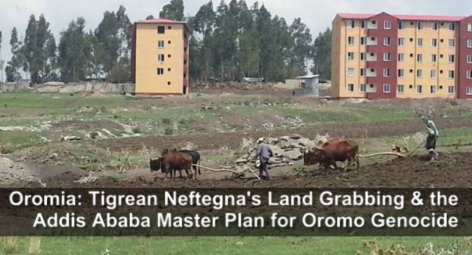
Oromia: “Say No” to Oppose Tigreans’ Master Plan – Which Is the “Master Killer” for Oromo Farmers

Say no to the master killer. Addis Ababa master plan is genocidal plan against Oromo people
Tigrean Neftengna's land grabbing and the Addis Ababa Master plan for Oormo genocide

Hundreds of Oromo (and friends of the Oromo) Facebook and Twitter users have changed their ‘profile pictures’ to the “Say No” graphic asnews broke out earlier on September 30, 2015, that the Tigrean-led Ethiopian government was advancing to finalize the “Addis Ababa Master Plan” through its agent OPDO. The “Addis Ababa Master Plan” aims to evict millions of Oromo farmers from the Oromia Federal State’s localities around Finfinne (Addis Ababa) in order to take the land for Tigrean investors, Tigrean real-estate developers and Tigrean commercial farmers while Oromo farmers will become day-laborers (unskilled workers), guards, housemaids, etc. (i.e. low-wage earners) on the Tigrean investment hub (called “Industrial Zone”) in Central Oromiyaa. In addition to Central Oromiyaa, these Tigrean “Industrial Zones” are to be built all over Oromiyaa near major cities/towns, such as the Dire-Dawa Industrial Zone near Dire-Dawa, the Jimma Industrial Zone near Jimma city, and so on – more details can be read here.
Say no to the master killer. Addis Ababa master plan is genocidal plan against Oromo people. Say no.