The following is a statement from the Central Committee (CC) of the Oromo Liberation Front-Change (OLF-Change). The statement is in Afan Oromo and English. In the statement, the Central Committee says, “The committee considered all matters that caused the removal, and accepted the decision of the Executive Committee. Until they choice the permanent leader, the committee has appoint three individuals: Dr. Nuro Dedefo, Chairperson; Brigadier General Hailu Gonfa, Head of Political Affairs; and Mr. Kassim Abbaa Nasha, Head of Foreign Relations.”
—————————-
OROMO LIBERATION FRONT Press Release
The Oromo Liberation Front (the OLF) Central Committee has held an emergency meeting on October 25, 2014.
In this meeting, the Committee has discussed the removal of General Kamal from the chairmanship of the OLF on October 23, 2014 by Executive Committee.
The committee considered all matters that caused the removal, and accepted the decision of the Executive Committee. Until they choice the permanent leader, the committee has appoint three individuals: Dr. Nuro Dedefo, Chairperson; Brigadier General Hailu Gonfa, Head of Political Affairs; and Mr. Kassim Abbaa Nasha, Head of Foreign Relations. The rest of the executive leaders names will be announced subsequently.
The Central Committee directs the new leaders to focus on the directive it gave to Executive Committee last year that is to work without precondition with all political organizations that struggle to dismantle the oppressive Woyyanne regimes that all peoples in Ethiopia live in peace, freedom and justice.
Oromo Liberation Front Central Committee
October 26, 2014
The Oromo Liberation Front (Popularly known as OLF for change) chairman, Brigadier General Kamal Galchuu has been removed from his position effective immediately.
Kamal Galchu since he came to the helm of the OLF, he has caused great destruction to the functions of the organization as a result of his poor leadership qualities and dictatorial actions.
On numerous occasions he has been counseled to change his controlling and tyrannical behaviors in order to uphold the organization’s bylaws. In addition, he was continuously counseled to focus on the main objectives of the OLF, which is to unite the Oromo people and lead a unified struggle against tyrannical rule in Ethiopia. Unfortunately, he has resisted any initiative to bring different Oromo political organizations to form unit against the Wayyane regime. His irresponsible and tyrannical actions has deterred (OLF Change) from creating a relationship and cooperation between other Oromo Political groups. As chairman, G/ Kamal Galchu has led our organization on the path of political and material corruption by further annihilating the organization from implementing positive changes that serve the interests of the Oromo people as a whole.
G/Kamal Galchu has violated the laws he initially took an oath to uphold to serve his personal benefits and spread false propaganda among members of the organization, making it difficult to implement effective change. There is no a greater betrayal and shame than one who compromises a national struggle for personal benefits, the leadership of General Kamal Galchu displays an outright violation similar of that of tyrannical leaders in Ethiopia. He ran the organization on the platform of absolute tyranny, led by one man and for one man only, by creating an environment that made it difficult, if not impossible, for members to work towards the organization’s goals. This was prevalent when he chose not to abide by the rules of the organization and pushed for deleterious aims in order to advance his personal gains.
His actions led the organizations on a detrimental path and made it difficult for our objectives to become a reality. Essentially, his tyrannical motives have brought great havoc to everyone in the
organization and the broader national struggle of the Oromo people. He displayed oppressive and authoritative behaviors of his former boss Meles Zenawi, whilst enhancing his personal motives at the expense of the cause. He uses divide and rule system of the Wayyane regime that has applied against our people in similar in its context within the organization.
The Oromo Liberation Front, in particular, and the Oromo people in general, do not have any more tolerance for such tyrannical behaviors, which is contrary to the egalitarian Gadaa democracy, which our ancestors gave to our people. The Oromo people have sacrificed the ultimate sacrifice to establish a source of true democracy, rule of law and human rights for all. We certainly cannot allow any tyrannical and self-interested leaders to keep the Oromo people from attaining their freedom. His actions are blatantly shameful, instead of listening to the council and advice of many leaders and elders, Oromo elites and think thank within the organization at different levels; he disregarded his duties and responsibilities by continuously violating our constitution that mandate collective leadership. By violating the collective leadership principles enshrined in our organization’s constitution, he has already removed himself from a position he was chosen to serve whilst creating a hostile environment for other loyal members. These behaviors display anti-democratic principles and utter disregards for rule of law, placing him in a position of the same authoritative leaders we took an oath to fight by all means.
In order to deter him from causing any further destruction and chaos to the organization’s objective, we have decided to remove him from his position as chairman of (OLF for Change). In accordance to our bylaws, formal and informal mediations, we have implemented all available strategies to resolve the issue. However, all our efforts fell on deaf ears of an individual who was determined to destroy the organization, by turning collective leadership embodied in our organization’s constitution into a single person controlled entity, which we are afraid greatly resembles that of his former boss, Melese Zenawi. General Kamal Galchu, by conducting in all of these destructive actions has lost the moral and legal ground to continue to lead our organization. Allowing him to continue with his dictatorial actions will destroy an organization, thousands, if not millions have lost their lives and are still losing to maintain. His lack of leadership skills has been a complete abomination. He has lost the trust, confidence and respect of the organization, both as a leader and a person.
Therefore, we the Executive Committee of the organization (OLF) made political decision and announce that general Kamal Galchu purged from his chairman position of the organization. Until the general assembly of the organization holds an official meeting and chooses a new Chairman/Chairwoman, senior members from the Executive Committee and National Council will lead the organization.
We will also take this opportunity to call upon leaders, individuals and groups who left this organization because of G/ Kamal Galchu’s tyrannical behavior to come back. Let’s stand together, under a unified objective and lead this great organization to victory for our people. We
have no doubt that together; we can ensure great leadership with core principles that are based on teamwork, accountability & responsibility.
Finally, due to the mess that made by G/Kemal Galchu, the wayyane agents and those who have anti Oromo unity have infiltrated in our organization in the past. We assure that our organization has no fertile ground for the infiltrators and we call upon our members to give particular attention to watch infiltrators with great concern for the safety of our organization.
For Information contact: (1) Dr. Nuro Dedefo, jibbaa.roorroo@gmail.com and Phone No.
(612)559-0489
(2) Brigadier General Hailu Gonfa, dhugaasaawaltajjii@gmail.com,
Phone No. +2917179 153
(3) Dhaabaa Gutamaa , dabagutema@yahoo.com , and phone No.
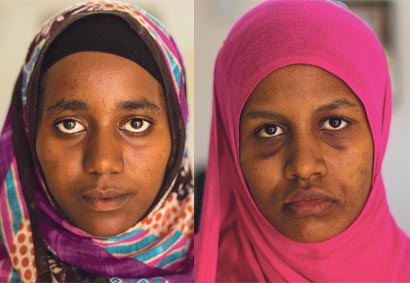
Two maids have spoken of the appalling abuse they claim was dished out by their employers, as a top diplomat called for an end to household “slavery”.
Hedja Ousman, 22, and Wube Tamene, 18, worked for families in the UAE and both say they were beaten, starved, and prevented from contacting their families in Ethiopia.
They have now sought refuge at the Ethiopian Consulate in Dubai.
Hedja, speaking to 7DAYS yesterday, told of the horrors she endured during the two years she worked for a Kazakh family in Ajman. She said her female employer didn’t like the prospect of the maid speaking to her husband.
She said: “My employer didn’t want me talking to her husband. Every time her husband would instruct me to do something, she would beat me.”
Hedja said the woman even cut off her hair to make her “less attractive”.
Hedja, who earned Dhs500 per month, said the abuse began three months after she started her job. She decided to escape last week when her employer accused her of stealing car keys and beat her.
“I saw the door open and I ran,” she said. I asked someone for water, they called the police for me. I’ve been at the consulate since. I want to go home.”
She has dropped the police case she had filed against her employer but the consulate says it intends to file a new one.
Wube worked for an Emirati family in Dubai and claims at one point she was starved for two days then shown a plate of food, which she thought was hers, only for her employers to throw it in the bin.
Ethiopia’s Consul General in Dubai, Yibeltal Aemero Alemu, said he is seeing “a lot” of such cases, branding it “slavery.”
Housemaid Wube Tamene dreamed of a new life and a decent standard of living in the UAE.
Instead she was made to cut up her clothes and clean her employer’s home with the rags.
The Ethiopian, aged just 18, claims she was also made to walk around in bare feet and was not paid a salary for 18 months.
She also claims she was regularly beaten. Wube is now seeking refuge at the Ethiopian consulate in Dubai, along with fellow maid Hedja Ousman, who escaped an abusive employer – a Kazakh woman – in Ajman.
Their cases have prompted Ethiopia’s Consul General in Dubai, Yibeltal Aemero Alemu, to call for such “slavery” to stop.
Alemu said the consulate is now seeing “a lot” of cases in UAE and has said his office would begin pursuing cases against abusive families.
He said: “These maids have no communication to the outside world, they’re starved and beaten – this is slavery.
“They’re not allowed to have mobile phones. To exploit the maids employers don’t let them communicate with their families back home, so they won’t run away for other opportunities.”
Recalling her abuse, Wube said: “When my employer wanted to get rid of me she made me sign a contract in Arabic that I have settled everything with her. But I didn’t understand what I was signing.
“She took me to the airport without shoes and any luggage, gave me my flight tickets and asked me to leave.
“But I was stopped by authorities. They said ‘where are you going without shoes?’” Consul-General Alemu said Wube has now received her outstanding salary of Dhs9,000 and will be heading back to Ethiopia today.
Ethiopia currently has a ban on its nationals coming to the UAE as domestic workers, but Alemu said the two maids started work before his government implemented it last year. Addis Abada said such a ban would remain in place until there is an agreement reached to protect its nationals from abusive employers.
“There are 90,000 Ethiopians in the UAE and most of them are maids,” Alemu said.
Lola Lopez founder of the humanitarian group Babies Behind Bars, which also helps maids who are abused, said some were being denied basic human rights.
She said: “Some people have no regard for human life. Welfare organisations haven’t been able to help much, because the message they send out doesn’t always reach the women it’s supposed to. Many of these maids don’t read the newspaper and they don’t have phones.
Three decades after images that shocked the world, country has become darling of the global development community – and the scourge of the human rights lobby
A man walks past a portion of the Addis Ababa light railway under construction in Addis Ababa. Photograph: Carl de Souza/AFP/Getty Images With an Einsteinian shock of hair and a wise man’s beard, Mulugeta Tesfakiros, just off a flight from Washington, settled into an office of glass walls and vibrant artworks in Addis Ababa. The millionaire magnate, who has gone into the local wine business with Bob Geldof, mused on the new Ethiopia: “Most of the people need first security, second food … and democracy after that.”
An hour’s drive away stand the corrugated iron watchtowers of a prison. The inmates include nine bloggers and journalists charged with terrorism. Standing in a bleak courtyard on a family visit day, they talked about how they had been tortured.
“I feel like I don’t know Ethiopia,” one said. “It’s a totally different country for me.”
This is the Janus-faced society that is the second most populous country in Africa. A generation after the famine that pierced the conscience of the world, Ethiopia is both a darling of the international development community and a scourge of the human rights lobby. Even as investment conferences praise it as a trailblazer the entire continent should emulate, organisations such as Human Rights Watch (HRW) describe it as “one of the most repressive media environments in the world”. Ethiopian children in a refugee camp during the famine.Photograph: William Campbell/Sygma/CorbisTo be in Ethiopia is to witness an economic miracle. The country has enjoyed close to double-digit growth for a decade. One study found it was creating millionaires faster than anywhere else on the continent. The streets of Addis Ababa reverberate with hammering from construction workers as the concrete skeletons of new towers and a monorail project rise into the crane-dotted sky. Ethiopia’s government says it is on course to meet most of the millennium development goals and, by 2025, to be a middle-income country.
Yet the frenetic urban expansion has uprooted thousands of farmers while, critics say, those who speak out against it are rounded up and jailed. Of 547 MPs, only one belongs to an opposition party. Activists and journalists describe an Orwellian surveillance state, breathtaking in scale and scope, in which phone conversations are recorded and emails monitored by thousands of bureaucrats reminiscent of the Stasi in East Berlin. The few who dare to take to the streets in protest are crushed with deadly force. Amnesty International has called it an “onslaught on dissent” in the runup to elections next year. The architect of this ostensibly Chinese model of development – or “authoritarian developmentalism” – in east Africa was the late prime minister Meles Zenawi, who appeared to set the blueprint with his remark: “There is no connection between democracy and development.” When Meles died in 2012 after 21 years in power, the UK prime minister, David Cameron, described him as an inspirational spokesman for Africa, while the former PM Tony Blair, whose autographed photo adorns the five-star Sheraton Addis hotel, spoke of his “great sadness”.
Among the winners of the Meles legacy is Tesfakiros, the head of the Muller Real Estate company with a business empire that includes logistics, transport, food manufacturing and the wine venture with Geldof, which last year made a profit of $5m (£3m). “We’re trying to put Ethiopia as a wine-producing country like California or South Africa,” he said.
Ethiopia also imports about 10m litres of wine a year to serve a growing middle class, a concept that would have been unthinkable to viewers of the images of helplessness and starvation that spurred Band Aid in 1984.
“People would be surprised. It’s very hard for them to believe,” Tesfakiros reflected. “There has been amazing growth in the last 15 years. People have got the work ethic and are investing. The real estates market is booming and will boom for a time.”
He praised prime minister Hailemariam Desalegn’s government for ensuring peace, encouraging domestic entrepreneurs and attracting investment from China, India and the west. Asked if all this was at the sacrifice of democracy, Tesfakiros replied: “What’s democracy? The opposition needs support by the middle class. When we have a middle class, we will have a stronger democracy. Until then, we have a nanny for the democracy. Democracy is a matter of education and civilisation – 85% of our population is farmers; we don’t know how to read and write. When you have a middle class, you push for your rights.” Men walk along a road with cattle near turbines at Ashegoda wind farm in the northern Tigray region.Photograph: AFP/Getty ImagesIf progress means surrendering civil liberties, including his phone calls being tapped, that is a price Tesfakiros is willing to pay. “If they listen and make the country safer, I don’t care. In America they do it, in Europe they do it.”
Independent journalists have described telephone conversations they had years ago being played back to them during interrogations. This year an investigation by HRW noted the government had complete control over the telecoms system and virtually unlimited access to the call records of all phone users. Most of the technologies were provided by the Chinese telecoms firm ZTE, it said, while Ethiopia also appears to have used tools made by UK, German and Italian companies in the UK, Germany and Italy.
Some believe the spying programme is so sophisticated that it must have western support at government level. Ethiopia is seen as a reliable police officer in the region, hosting a US military base and sending troops to fight the Islamist militant group al-Shabaab in neighbouring Somalia. Advocates of its hardline security approach – patrons of the leading coffee shop chain are patted down on entry – point out that it has not suffered atrocities like Kenya, which is also engaged in Somalia.
The three journalists and six bloggers arrested in April and charged with terrorism in July are accused of planning attacks in Ethiopia and working in collusion with Ginbot 7, the US-based opposition group labelled by authorities as a terrorist organisation. They deny the charge and say they have been tortured. During the visit by the Guardian to the prison on the outskirts of Addis Ababa, one said he had been locked in a 20 sq metre room with 100 inmates.
“It’s not just the slapping you or beating you on the feet, it’s the way they wake you in the middle of the night in that shitty room where you’ve tried so hard to sleep,” the prisoner said above the noise of fellow inmates and their relatives. “It’s mental as well as physical torture. For a person who followed the world and was on the internet 24 hours, I feel like I’m shut down here. The only freedom I have here is thinking. They can’t stop me thinking, but even that is distorted.”
Hope is fading for the group as they get caught in the cogs of the court system. “We feel this is our new life. We know from the past experience of others that we have started a prison life already. There’s not going to be any bail; it’s going to be waiting day after day. Even though we know we are innocent, we know we have to accept it. The only choice we have is to smile or cry – and we want to cry about it.”
They are not the only journalists and activists behind bars. In June, Andargachew Tsige, a Briton of Ethiopian origin and secretary general of Ginbot 7, was seized at a Yemeni airport and illegally extradited to Ethiopia, where he could face the death penalty. Opposition parties, who boycotted parliament after the last election, say their members have been incarcerated, or worse.
The Oromo Federalist Congress, representing Ethiopia’s biggest ethnic group, is resisting the government’s “masterplan” for expanding Addis Ababa, claiming it has forced 150,000 Oromo farmers off their land without compensation. Witnesses say police killed at least 17 protesters, including children and students, during demonstrations this year and hundreds more are being detained without charge.
While tycoons such as Tesfakiros are showered in money from the property boom, Bekele Nega, general secretary of the congress, which has more than 10,000 members, has a different perspective. “This we don’t consider ‘development’,” he said. “This we consider the uprooting of the indigenous people, who will lose their culture and identity. The government say they are expanding Addis Ababa but the reality is they are getting rid of the people who don’t support the EPRDF [the ruling Ethiopian People’s Revolutionary Democratic Front].” Traffic passes along a street with buildings under construction in Addis Ababa.Photograph: ReutersHe challenged the west’s perceptions of positive change in the country. “Foreigners who see these tall buildings will say Ethiopia is developing. The reality is we are not developing. We are not having three meals a day. People like Bob Geldof and others consider they have helped our people and of course they have. But they didn’t come to the kernel of the matter. The EPRDF used the money from that time to build the empire they are in control of. Somebody hijacked the money from that hunger. It’s written in black and white.”
Ethiopia is still one of the biggest recipients of UK development aid, getting about £300m a year. Money also pours in from the US. Nega believes it is misspent: “The west has left us, left the people. The US is aiding dictators and turning a blind eye to us. Why? The same with Britain, which has democratic values. They give the taxpayers money for buying weapons or for the police station to handcuff people.”
Donor aid is also helping the government to spy on its citizens and even turn family members against each other, he alleged. “For any five family members, one will be reporting to the police. Your brother or your sister or your mother.
Ethiopia has turned its back on the concept of western liberal democracy, Nega said. “Whether we like it or not, we are in the Chinese developmental state. The west wants us to be democrats and build a democracy. This question is not comfortable for our leaders. According to them, we need only food. They don’t understand that poor people need democracy. They fact we are poor does not mean we are not human beings. We cannot be uprooted and tormented.
“As human beings we deserve democracy, human rights, rule of law. Until we get it, we’ll go on demanding it, even at the cost of our own lives. We are demanding it for the sake of our children. Maybe tomorrow, maybe today, any day I could be in prison. But I have my tongue and my pen and they cannot drive me back from telling what I know and believe. I hope the world will know what the reality is.”
Similar criticism of the disjunction between economic progress and political freedom have been made of Rwanda under Paul Kagame. But Ethiopia is much bigger. Its government is unrepentant and convinced of its mission. Any hint of doubt would seem like weakness. One senior official said: “The most basic human right is food on the table. If we’re doing that, why would we violate other human rights? This is a safe, secure place and we want to keep it that way. We’ll do anything to keep it that way. We have 90 million people – you try to control them.”