Saturday, October 19, 2013

Letter to Madame Fatou Bensouda of ICC

From Macha Tulama Cooperative and Development Association USA

18 October 2013
Madame Fatou Bensouda,
Chief Prosecutor, Office of the Prosecutor of
the International Criminal Court (ICC/OTP)
The Hague, Netherlands
Dear Madame Bensouda,
It is deeply concerning to learn that Ethiopia, Kenya and Sudan have drafted plans to undermine the International Criminal Court (ICC) at the October 11- 12, 2013 African Union meeting in Addis Ababa Ethiopia. The plans were to oppose ICC efforts to bring dictators and heads of state in Africa to justice, particularly those who committed atrocities. Attempts by some AU members include delays into the investigation of President Uhuru Kenyatta and William Ruto, who were alleged to have a role in the 2007 Kenyan election violence. Macha Tulama USA is concerned that these efforts are designed to hide crimes committed on the continent, including joint efforts between Governments such as Ethiopia, Kenya, Sudan, Djibouti and Somalia.
In the case of Ethiopia, it is well documented that the Northern Ethnic groups, Tigrayan and Amhara, have committed egregious human rights violations and genocide of people groups in South and Central regions. Many human rights advocacy groups have documented these human rights violations including against people from the Omo valley, regions of Oromia, Ogaden, Sidama, Anuak, and Afar.
ETHIOPIA
HISTORICAL REFERENCE
Oromo who make up more than 40% of Ethiopia’s population have been marginalized by occupying ethnic groups, Amhara (Abyssinians), since Oromo lost independence. Soon after Abyssinians annexed Oromia, the Abyssinians committed Genocide against Oromo and other Southern nations. In the case of Oromo, estimated figures of dead were close to 5 million, with many deaths at Aanoolee and Calaanqo, Oromia.
A February 26, 1895 New York Times article references atrocities by Abyssinian Emperor Menelik II in the late 1880s. The article, “Menelek’s Terrible Expedition,” cites the Tribuna and reports that King Menelik massacred 70,000 Oromo and captured 15,000 at one location.
HUMAN RIGHTS VIOLATIONS
Human Rights League of the Horn of Africa, Oromo Support Group, Human Rights Watch, US State Department, Government of Australia, Genocide Watch and Amnesty International are among governments and NGOs that documented human rights abuses by the Government of Ethiopia (GOE).  These violations of human rights include instances where GOE:
  • used paramilitary groups to carry out extrajudicial torture, detention and killings against particularly Oromo people. The resulting consequence is a large exodus of Oromo refugees. In 2012, more than 75,000 refugees crossed over to Yemen from Somaliland by way of human traffickers. It is believed that more than 50% are Oromo.
  • forced farmers off indigenous land for sale to large commercial farmers from Middle East, Asia and Europe (land grab). This has been occurring in large scale on Gambella and Oromo regions.
  • forced relocation of indigenous pastoralists from ethnic people of Omo valley for the Gibe III hydroelectric dam. The forced relocation includes killings members of their communities.
  • targeted killings of Oromo refugees in neighboring countries such as Somaliland, Djibouti, Puntland, and Kenya.
  • Forced refoulement of Oromo refugees in neighboring countries including those who have UNHCR Mandates and who are to be protected by Article 3 of the Convention against Torture. Article 3 states that:
No state party shall expel, return (“refouler”) or extradite a person to another state where there are substantial grounds to believe that they would be in danger of being subjected to torture.
One recent case of Oromo refugee being refouled, then tortured and killed in an Ethiopian prison is that of Mr Tesfahun Chemeda. The killing of Mr Tesfahun Chemeda was documented by the following:
OROMO PERSPECTIVE
One Oromo perspective on Human rights abuses was recently aired by Al Jazeera in a panel discussion on Oromo Seek Justice in Ethiopia. The discussants explained that Oromo are targeted by GOE through discrimination and violence for being ethnic Oromo. Some believe the targeting is out of fear of relinquishing power through elections to a people they occupy, reminiscent of the former Apartheid system of South Africa.
Many of the GOE policies were geared around ensuring restricted access of Oromo to available protections and development instituted by UN and other international organizations. Ethiopia’s 2009 Charities and Societies Proclamation Act is one example where laws were enacted to implement Ethiopian targeted policies against many, particularly Oromo. Amnesty International report, ‘Stifling human rights work: the impact of Ethiopia’s civil society legislation’, provides analysis of the 2009 Act. Amnesty’s report stated:
“The law has had a devastating impact on human rights organizations, and has significantly restrained human rights defenders from conducting their legitimate and vital role in civil society. The country’s leading human rights organizations have lost almost all of their income because of the funding restrictions. Further, these organizations have been subjected to enforced changes of mandate, programme activities or the name of their organization.”
Human Rights Watch recently conducted research into Ethiopian prisons and published ”They want a confession.” The report confirms the Oromo perspective, particularly as it relates to GOE targeting Oromo:
“Ethiopian police and other security forces are regularly implicated in arbitrary arrest and detention and the violation of basic due process rights. Those particularly vulnerable to such abuse include activist students; protesters; journalists; members of the political opposition, particularly ethnic Oromo parties; alleged supporters of insurgent groups, such as the Oromo Liberation Front (OLF) and the Ogaden National Liberation Front (ONLF); and anyone suspected in broadly defined “terrorist” activities.”
OROMO REFUGEES
Oromo refugees experience the external policies of GOE through human rights abuses outside of Ethiopia in places such as Djibouti, Somaliland, Puntland, Kenya, Sudan and Yemen. The GOE has established military and security cooperation with many of those countries. An end result is violations of international laws and agreements, particularly on human rights. Many of the violations include:
  • establishing refoulement of Oromo as a common practice
  • executions of Oromo civilians in other countries
  • blocking international assistance in third countries of Oromo Refugees (men, women and children) particularly on health needs
It is this established cooperation that requires urgent action by the International community, as it lays the ground work for continuation and worsening of human rights violations.
RECOMMNEDATIONS:
It is known that Ethiopia refuses to sign the Rome Statute. It is deeply concerning to know that in addition to rejecting International norms on protection of civilians, the GOE is actively engaged in pressuring other African Countries to disassociate with ICC objectives in order to legitimize Ethiopian inhumane acts.
  • We urge ICC to continue and not be deterred by agents who seek to block protection of humanity, particularly those who believe it is their right to persecute oppressed people.  Doing so will strengthen efforts of the International Community in protecting innocent civilians throughout the world.  In Uganda, it is reported that many are concerned with election related violence. If the will of some AU members is allowed, those who incite violence will continue to act without impunity.
  • We urge ICC to work closely with Human Rights groups, Oromo advocacy groups and organizations to investigate Ethiopia even though they are not signatures to the Rome Statute
Sincerely,
Mardaasa Addisu
Secretary of Macha Tulama Cooperative and Development Association
http://www.machatulama-usa.org/

REFERENCE ON ETHIOPIAN HUMAN RIGHTS VIOLATIONS
Abductions and Refoulement of Oromo Refugees from neighboring countries
Djibouti December 31, 2012 A Human Rights League of the Horn of Africa Press Release (HRLHA UA NO 2013) reports on abduction and refoulment of Oromo and Ogaden refugees including those with UNHCR Mandates. It was reported by several sources that the refugees are in Dire Dewa prison in Ethiopia.
*UNHCR Case # COM-13-0045 recently opened on this incident.
Somaliland November 23, 2012 Attached is the HRLHA report on Ms Riyana Abdurahman Yusuf, who was taken by Somaliland Security and refouled. It was last reported that she was held in a prison in Ethiopia Jigjiga Ogaden.
Somaliland August 31, 2012  Former UNHCR Somalia Head Bruno Geddo documented incident at Social Welfare Center in Hargeisa where Somaliland Police and locals attacked many Oromo refugees and asylum seekers. The incident was compounded by attempt to refoul a large group of Oromo refugees and mandate holders. According to Mr Bruno Geddo, and local contacts, UNHCR successfully returned 73 Oromo refugees after aggressive lobbying with Somaliland authorities. Many Asylum seekers were refouled, despite UNCHR attempt according to Bruno Geddo. Over 26 Oromo refugees remained in Somaliland prison for more than a month after the incident. After their release, a large group left for Puntland.
Somaliland December 22, 2011 Attached is a report published around the time Somaliland tried to hand the refugees and asylum seekers to Ethiopian officials. Ms Riyana Abdurahman Yusuf’s father were among those Somaliland tried to refoul. He is currently in Djibouti as a UNHCR mandate holder.
  Oromo Support Group Reports on Djibouti and Somaliland provide great details on torture of Oromo and Ogaden refugees by the Ethiopian Government as well as human rights violations in those respective countries.
Djibouti: destitution and fear for Refugees from Ethiopia
Persecuted in Ethiopia: Hunted in Hargeisa
A number of contacts within State Department Population Refugee and Migration Bureau have done a great deal of lobbying to free detained Oromo in places like Somaliland. However, I believe a stronger multiagency cooperation is required to develop policy that mitigates the inhumane practices by the Government of Ethiopia. These policy should include reduction and or elimination of military Aid, which is ligely used against Oromo and other nations within the Ethiopian empire. Many of the actions of the Government of Ethiopia demonstrate a genuine disregard for human life including against women, children and men of all ages.
Region Mixed Migration Secretariat and Danish Refugee Council
In October 2012, the RMMS produced a brochure on refugees in Yemen who fleed Ethiopia. In the booklet, desperate choices,  RMMS researchers identified that the majority of refugees are Oromo.
The following was taken from the document:
“The Oromo and Ogaden qualify for refugee status because of their political marginalization and persecution by the authorities, but the status of other Ethiopians who also experience marginalization as a result of their political views is unclear. The Ethiopian Government is becoming increasingly defensive towards any opposition and outlawing democratic activities such as freedom of speech,as well as closing down local human rights NGOs with more than 10 per cent external funding under the Charities and Societies Proclamation Law of 2009. “
The RMMS booklet reports on violent crimes against women including kidnapping and rape. Three Oromo who lived in Yemen since 2003, told RMMS researhcers that they had
“.. been tortured and detained by the regime.
Even in neighbouring countries immigrants are
kidnapped, tortured and killed (…) Women refugees
are raped in a house they are working by Yemenis.
They even raped in the street.”
One Oromo farmer from Jima reported leaving Ethiopia to pay off debt incurred when:
“Government officials had forced them to purchase fertilizer for their crops from a Government supplier. The high prices and subsequent poor harvests meant that they had become indebted..”
In other instances, it was reported that Human Traffickers coercise local farmers in Oromia (and elsewhere) to work on Qat farms in Yemen. Once in Yemen, the victims are forced to work long hours.
In the report, RMMS researchers identified that Tigray gangs operate in Sa’ada transporting weapons and drugs for Houthis. It is Tigray ethnic group who control Ethiopia today.
Human Rights Abuse by Government of Ethiopia and their subset Paramilitary groups
The Ethiopian Government has specifically targeted Oromo people. The Government uses direct acttacks on Oromo as well as paramilatary groups like the Liyuu Police, and those in Benishangual region (West Ethiopia). Typically, the regime presents the confrontations as inter ethnic fighting, however, the civilians know that we have had there existed peace between ethnic groups until insighted by the Government.
A March 12, 2013 Al Jazeera report on Ethiopia’s Anti Terror law included an interview of one of two Swedish Journalist, Martin Schibbye, captured by Ethiopion forces along with Liyuu police. During the interview, Martin revealed the brutal treatment by GOE forces, followed by forced confessions that he was a terrorist. Martin also described how they carried out mock execution of him prior to being transported to Addis Abeba for trial.
It is not only Oromo civilians that are attacked in Ethiopia. Somalia from Ogaden region, Anuak from Gambella, Benishangul and Sidama people all face very similar attacks on civilian population.
  • Attached is a report of recent killings by paramilitary groups under Ethiopian government in Ogaden region.
  • The following is the report posted on Somaliland press regarding Ethiopian paramilitary group Liyuu Police (along with Ethiopian federal troops) showing the capture of the two Swedish journalists
  • The Federal Defense Army and Rapid Action Troops ‘fetno-derash’ are also notorious for attacks on civilians. While the current Prime Minister Hailemariam Dessalegn was the President of Southern region in 2002, Sidama people were massacred by the Rapid Action Troops at the village of Loqe near Hawassa town. It was reported that his Vice President at the time, Melese Marimo, ordered the shooting of peaceful demonstrators.
Similar cases are reported in Oromo and Benishangul-Gumuz regions. Please see Benishangul Human Rights Press Release in 2009 illustrating that many locals from Oromo and Benishangual community suspect atrocities committed in the Benishangual region were orchestrated by Ethiopian Federal Security.
The following are two important texts from the press release.
“An example of such an action occurred on June 21, 2008 when credible sources from the ground reported that Ethiopian government security forces combined with the Ethiopian National Defense Forces to attack Benishangul villages, killing hundreds. Many others were displaced, disappeared or were arrested, many later being tortured to death.”
Regarding Oromo and Benishangul people:
“The Oromo and Benishangul people have lived together for centuries, but reports on both sides indicate evidence or suspicion that the Meles regime was behind both attacks; something that will require all of us to come together to prevent either side from being used or scapegoated. Government sympathizers from one ethnicity have been used, at times, to carry out the regime’s schemes against those of another ethnicity. Conversely, the innocent have been blamed for acts they did not commit.”

Oromo youth in the Netherlands reaches out to the host community

Oromo youth in the Netherlands reaches out to the host community

Oromo youth has organized a meeting which was held on 10.12.2013 in Amsterdam, the Netherlands. The aim of the meeting was to bring attention to Oromo’s generations old plight in Ethiopia. The organizers hoped to reach out both to the Oromo community and to the host community in the Netherlands. The meeting which was organized under the banner of ‘Oromo’s plight in Ethiopia’ discussed on various issues ranging from current political situation in Ethiopia, human rights abuses perpetrated against Oromo and Oromo’s long and difficult journey towards freedom.
At this meeting various speakers gave spectacular speeches which focused on historical accounts of Oromo people and its long journey to freedom. Particularly the speech given by Mr. Mulugeta Mossisa highlighted the political contour of Oromo struggle for freedom. He discussed past and the present situations of Oromo people emphasizing on the contribution many Oromo national figures have made to fight injustice and abhorrent subjugation. He also touched on specifically what young generation has to contribute in order to make the dream of fallen Oromo heroes and heroines come true.
The meeting was aimed to increase the level of awareness particularly among the host community about political realities in Ethiopia and widespread human right abuses in the country. As part of the meeting, there was cultural event in which artists such as Mahdi Sheka, Hangatu Balcha, Tulu Amante Jaleta (also one of the organizers) and others entertained the guests and participants of the meeting.
Mr. Bayisa Ayana and Mr. Abdella Kedir Mohammed, both are members of the organizing committees, believe that such a meeting plays crucial role in order to reinvigorate Oromo struggle for freedom by bringing Oromo together and providing them a platform where they can discuss issues and ideas of great relevance for Oromo community in the Netherlands and human rights abuses Oromo in Oromia has to face on regular basis. Other participants, Cala Alfa Moti, Nasir Hussein, Umar Biftu and Gadaa Hunde, hope that the meeting would create enormous opportunity for the host community, especially for those who participated in the meeting, get first-hand accounts of Oromo’s suffering and why Oromos are becoming refugees in increasing numbers from those who faced irreprehensible repression, torture, trauma and all kinds of despicable abuses under the current regime.
The event was organized by Oromo youth in the Netherlands and received substantial financial and logistical support from church leaders and individuals. The meeting would have not been successful had it not been due to relentless support of Deacon Jasper. Such a meeting was the first of its kind in the Netherlands. The organizers of the meeting, encouraged by what has been achieved, have plans to organize meetings of similar kind to engage Oromo and to reach out to the host community even in a much bigger and broader fashion. Reaching out to the host community and making Oromo cause for freedom and justice, Mr. Abadella K Mohammed and Faiz Ali are convinced, is best approach to win many friends for our struggle and another approach through which Oromo can mount international pressure on the regime in Ethiopia.
Oromo is the largest ethnic group in Ethiopia and the most persecuted ethnic group: deprived of any meaningful political role in the country and faced despicable economic marginalization which left millions in abject poverty.

Chaltu as Helen: an everyday story of Oromos traumatic identity change

Chaltu midhaksaby Tigist Geme
(OPride) – Author and novelist Tesfaye Gebreab released his eighth book “Ye Sidetengaw Mastawesha”  an immigrant's memoir ­– online, as a free PDF, after an alleged fallout with his publisher,Netsanet Publishing Agency (NPA).
The dramatic decision to distribute the book for free – at an estimated loss of $30,000 – came, according to Tesfaye's people, after NPA leaked a doctored copy of the book following the author's refusal to omit two controversial chapters, one of which is about Oromo.
Tesfaye is not new to controversy, especially one involving the divergent Oromo and Ethiopian narratives. His well-received book, YeBurqa Zimita – the silence of Burqa – is the first major work of contemporary Amharic fiction with main Oromo characters based on a true story.
Tesfaye, who is of an Eritrean descent, grew up in Bishoftu in Oromia, central Ethiopia. He identifies himself as "Ijjoollee Bushooftu" meaning a proud Bishoftu native. His third major novel "Ye Bishoftu Qorxoch" and two subsequent memoirs, although less controversial, dealt with the plight of Oromo people under successive Ethiopian regimes.
Suffice to say, over the years, Tesfaye had distinguished himself as a controversial, introspective, and critical novelist by going against the tide of mainstream Ethiopianist narrative. For this, he’s been accused of many things, like being a paid Eritrean spy.
In the latest disputed book, one of the chapters that the publishers allegedly sought to censor was “Chaltu as Helen”, which is based on a novelized story of Chaltu Midhaksa, a young Oromo girl from Ada'aa Barga district, also in central Oromia.
Born to a farming family in Koftu, a small village south of Addis Ababa near Akaki, Chaltu led an exuberant childhood. Raised by her grandmother's sister Gode, a traditional storyteller who lived over 100 years, the impressionable Chaltu mastered the history and tradition of Tulama Oromos at a very young age.
Chaltu’s captivating and fairytale like story, as retold by Tesfaye, begins when she was awarded a horse named Gurraacha as a prize for winning a Tulama history contest. Though she maybe the first and only female contestant, Chaltu won the competition by resoundingly answering eleven of the twelve questions she was asked.
Guraacha, her pride and constant companion, became Chaltu's best friend and she took a good care of him. Gurraacha was a strong horse; his jumps were high, and Chaltu understood his pace and style.
A masterful rider and an envy to even her male contemporaries, Chaltu soon distinguished herself as bold, confident, outspoken, assertive, and courageous. For this, she quickly became a household name among the Oromo from Wajitu to Walmara, Sera to Dawara, Bacho to Cuqala, and Dire to Gimbichu, according to Tesfaye.
Chaltu traces her lineage to the Galan, one of the six clans of Tulama Oromo tribe. At the height of her fame, admirers – young and old – addressed her out of respect as “Caaltuu Warra Galaan!" – Chaltu of the Galan, and "Caaltuu Haadha Gurraacha!" – Chaltu the mother of Gurraacha.
Chaltu's disarming beauty, elegance, charisma, and intelligence coupled with her witty personality added to her popularity. Chaltu's tattoos from her chin to her chest, easily noticeable from her light skin, made her look like of a “Red Indian descent” (Tesfaye's words). 
As per Tesfaye's account, there wasn’t a parent among the well-to-do Oromos of the area who did not wish Chaltu betrothed to their son. At 14, Chaltu escaped a bride-kidnapping attempt by outracing her abductors.
Chaltu's grandfather Banti Daamo, a well-known warrior and respected elder, had a big family. Growing up in Koftu, Chaltu enjoyed being surrounded by a large network of extended family, although she was the only child for her parents.
Recognizing Chaltu's potential, her relatives suggested that she goes to school, which was not available in the area at the time. However, fearing that she would be abducted, Chaltu's father arranged her marriage to a man of Ada’aa family from Dire when she turned 15.
Locals likened Chaltu's mannerism to her grandfather Banti Daamo, earning her yet another nickname as "Caaltuu warra Bantii Daamo" – Chaltu of Banti Daamo. She embraced the namesake because many saw her as an heir to Banti Daamo's legacy, a role usually preserved for the oldest male in the family. Well-wishers blessed her: prosper like your grandparents. She embraced and proudly boasted about continuing her grandfather's heritage calling herself Chaltu Banti Daamo.
Others began to call her Akkoo [sic] Xinnoo, drawing a comparison between Chaltu and a legendary Karrayu Oromo woman leader after whom Ankobar was named.
Chaltu's eccentric life took on a different trajectory soon after her marriage. She could not be a good wife as the local tradition and custom demanded; she could not get along with an alcoholic husband who came home drunk and abused her.  
When Chaltu threatened to dissolve the marriage, as per Oromo culture, elders intervened and advised her to tolerate and reconcile with her husband. Rebellious and nonconformist by nature, Chaltu, who's known for challenging old biases and practices, protested "an alcoholic cannot be a husband for Banti Daamo’s daughter!”
Soon she left her husband and moved to Addis Ababa, Ethiopia's capital, to attend formal education and start a new chapter in life.
Trouble ensues.
In Addis Ababa, her aunt Mulumebet's family welcomed Chaltu. Like Chaltu, Mulumebet grew up in Koftu but later moved to Addis Ababa, and changed her given name from Gadise in order to ‘fit’ into the city life.
Subsequently, Mulumebet sat down with Chaltu to provide guidance and advice on urban [Amhara] ways.
“Learning the Amharic language is mandatory for your future life," Mulumebet told Chaltu. "If you want to go to school, first you have to speak the language; in order to learn Amharic, you must stop speaking Afaan Oromo immediately; besides, your name Chaltu Midhaksa doesn’t match your beauty and elegance."
"I wish they did not mess you up with these tattoos," Mulumebet continued, "but there is nothing I could do about that...however, we have to give you a new name."
Just like that, on her second day in Addis, Caaltuu warra Galaan became Helen Getachew.
Chaltu understood little of the dramatic twists in her life. She wished the conversation with her aunt were a dream. First, her name Chaltu means the better one, her tattoos beauty marks.
She quietly wondered, “what is wrong with my name and my tattoos? How can I be better off with a new name that I don’t even know what it means?"
Of course she had no answers for these perennial questions. Most of all, her new last name Getachew discomforted her. But she was given no option.
The indomitable Chaltu had a lot to learn.
A new name, new language, new family, and a whole new way of life, the way of civilized Amhara people. Chaltu mastered Amharic in a matter of weeks. Learning math was no problem either, because Chaltu grew up solving math problems through oral Oromo folktale and children's games like Takkeen Takkitumaa.
Chaltu's quick mastery amazed Dr. Getachew, Mulumebet's husband. This also made her aunt proud and she decided to enroll Chaltu in an evening school. The school matched Chaltu, who's never set foot in school, for fourth grade. In a year, she skipped a grade and was placed in sixth grade. That year Chaltu passed the national exit exam, given to all sixth graders in the country, with distinction.
But her achievements in school were clouded by a life filled with disappointments, questions, and loss of identity. Much of her troubles came from Mulumebet packaged as life advice.
“Helen darling, all our neighbors love and admire you a lot," Mulumebet told Chaltu one Sunday morning as they made their way into the local Orthodox Church. "There is not a single person on this block who is not mesmerized by your beauty...you have a bright future ahead of you as long as you work on your Amharic and get rid of your Oromo accent...once you do that, we will find you a rich and educated husband."
Chaltu knew Mulumebet had her best interest at heart. And as a result never questioned her counsel. But her unsolicited advises centered mostly on erasing Chaltu's fond childhood memories and making her lose touch with Oromummaa – and essentially become an Amhara.
Chaltu spent most of her free time babysitting Mulumebet's children, aged 6 and 8. She took care of them and the kids loved her. One day, while the parents were away, lost in her own thoughts, Chaltu repeatedly sang her favorite Atetee – Oromo women's song of fertility – in front of the kids.
That night, to Chaltu's wild surprise, the boys performed the song for their parents at the dinner table. Stunned by the revelation, Mulumebet went ballistic and shouted, “Are you teaching my children witchcraft?"
Mulumebet continued, "Don’t you ever dare do such a thing in this house again. I told you to forget everything you do not need. Helen, let me tell you for the last time, everything you knew from Koftu is now erased…forget it all! No Irreechaa, no Waaree, no Okolee, no Ibsaa, No Atetee, and no Wadaajaa."
Amused by his wife's dramatic reaction, Getachew inquired, “what does the song mean, Helen?" Chaltu told him she could not explain it in Amharic. He added, “If it is indeed about witchcraft, we do not need a devil in this house...Helen, praise Jesus and his mother, Mary, from now on."
"Wait," Getachew continued, "did you ever go to church when you were in Koftu? What do they teach you there?”
Chaltu acknowledged that she’s been to a church but never understood the sermons, conducted in Amharic, a language foreign to her until now. "Getachew couldn’t believe his ears," writes Tesfaye. But Getachew maintained his cool and assured Chaltu that her mistake would be forgiven.
Chaltu knew Atetee was not a witchcraft but a women's spiritual song of fertility and safety. All Oromo women had their own Atetee.
Now in her third year since moving to Addis, Chaltu spoke fluent Amharic. But at school, in the market, and around the neighborhood, children bullied her daily. It was as if they were all given the same course on how to disgrace, intimidate, and humiliate her.
“You would have been beautiful if your name was not Chaltu," strangers and classmates, even those who knew her only as Helen, would tell her. Others would say to Chaltu, as if in compliment, "if you were not Geja (an Amharic for uncivilized), you would actually win a beauty pageant...they messed you up with these tattoos, damn Gallas!"
Her adopted name and mastery of Amharic did not save Chaltu from discrimination, blatant racism, hate speech, and ethnic slurs. As if the loss of self was not enough, seventh grade was painfully challenging for Chaltu. One day when the students returned from recess to their assigned classes, to her classmate's collective amusement, there was a drawing of a girl with long tattooed neck on the blackboard with a caption: Helen Nikise Gala – Helen, the tattooed Gala. Gala is a disparaging term akin to a Nigger used in reference to Oromos. As Chaltu sobbed quietly, their English teacher Tsige walked in and the students' laughter came to a sudden halt. Tsige asked the classroom monitor to identity the insulting graffiti's artist. No one answered. He turned to Chaltu and asked, “Helen, tell me who drew this picture?"
She replied, “I don't know teacher, but Samson always called me Nikise Gala."
Tsige was furious. Samson initially denied but eventually admitted fearing corporal punishment. Tsige gave Samson a lesson of a lifetime: “Helen speaks two language: her native Afaan Oromo and your language Amharic, and of course she is learning the third one. She is one of the top three students in the class. You speak one language and you ranked 41 out of 53 students. I have to speak to your parents tomorrow."
Athletic and well-mannered, Chaltu was one of the best students in the entire school. But she could not fathom why people gossiped about her and hurled insults at her.
Banned from speaking Afaan Oromo, Chaltu could not fully express feelings like sorrow, regrets, fear and happiness in Amharic. To the extent that Mulumebet wished Chaltu would stop thinking in Oromo, in one instance, she asked Chaltu to go into her bedroom to lament the death of a relative by singing honorific praise as per Oromo custom. Chaltu’s break came one afternoon when the sport teacher began speaking to her in Afaan Oromo, for the first time in three years. She sobbed from a deep sense of loss as she uttered the words: “I am from Koftu, the daughter of Banti Daamo." Saying those words alone, which were once a source of her pride, filled Chaltu with joy, even if for that moment.
Chaltu anxiously looked forward to her summer vacation and a much-needed visit to Koftu. But before she left, Mulumebet warned Chaltu not to speak Afaan Oromo during her stay in Koftu. Mulumebet told Chaltu, “Tell them that you forgot how to speak Afaan Oromo. If they talk to you in Oromo, respond only in Amharic. Also, tell them that you are no longer Chaltu. Your name is Helen.”
Getachew disagreed with his wife. But Chaltu knew she has to oblige. On her way to Koftu, Chaltu thought about her once golden life; the time she won Gurracha in what was only a boys' competition, and how the entire village of Koftu sang her praises.
Her short stay in Koftu was dismal. Gurraacha was sold for 700 birr and she did not get to see him again. Chaltu's parents were dismayed that her name was changed and that she no longer spoke their language.
A disgruntled and traumatized Chaltu returns to Addis Ababa and enrolls in 9th grade. She then marries a government official and move away from her aunt's protective shield. The marriage ends shortly thereafter when Chaltu's husband got caught up in a political crosshair following Derg's downfall in 1991. Chaltu was in financial crisis. She refused an advice from acquintances to work as a prostitute.
At 24, the once vibrant Chaltu looked frail and exhausted. The regime change brought some welcome news. Chaltu was fascinated and surprised to watch TV programs in Afaan Oromo or hear concepts like “Oromo people's liberation, the right to speak one's own language, and that Amharas were feudalists.”
Chaltu did not fully grasp the systematic violence for which was very much a victim. She detested how she lost her values and ways. She despised Helen and what it was meant to represent. But it was also too late to get back to being Chaltu. She felt empty. She was neither Helen nor Chaltu.
She eventually left Addis for Koftu and asked her parents for forgiveness. She lived a few months hiding in her parent's home. She avoided going to the market and public squares.
In a rare sign of recovery from her trauma, Chaltu briefly dated a college student who was in Koftu for a winter vacation. When he left, Chaltu lapsed back into her self-imposed loneliness and state of depression. She barely ate and refused interacting with or talking to anyone except her mother.
One afternoon, the once celebrated Chaltu warra Galaan took a nap after a coffee break and never woke up. She was 25.
The bottom line: Fictionalized or not, Chaltu’s is a truly Oromo story. Chaltu is a single character in Tesfaye’s book but lest we forget, in imperial Ethiopia, generations of Chaltu’s had to change their names and identity in order to fit in and be “genuine Ethiopians.” Until recently, one has to wear an Amhara mask in order to be beautiful, or gain access to educational and employment opportunities.
Likewise, in the Ethiopia of today’s “freedom of expression advocates” – who allegedly sought to censor Tesfaye – it appears that a story, even a work of fiction, is fit to print only when it conforms to the much-romanticized Ethiopianist storyline.
So much has changed since Chaltu’s tragic death a little over a decade ago, yet, clearly, much remains the same in Ethiopia. Honor and glory to Oromo martyrs, whose selfless sacrifices had allowed for me to transcribe this story, the Oromo today – a whole generation of Caaltuus – are ready to own, reclaim, and tell their stories.
Try, as they might, the ever-vibrant Qubee generation will never be silenced, again.
--*The writer, Tigist Geme, is a DC-based citizen journalist and an Oromo rights activist. Editor's note: the above cover photo by William Palank is not in any way related to Chaltu or Geme's story. It is used here only as a place holder. 

Friday, October 18, 2013

Madda Walaabuu Media Foundation is to Launch a New Program to Oromia

October 18, 2013 (ayyaantuu.com) — In September 2013, after extensive consultation, over several months, with various segments of Oromo society, a group of community leaders, human rights activists, feminists, journalists and attorneys who are committed to the principle of democracy, human rights, freedom and justice, formed the Madda Walaabuu Media Foundation (MWMF).
The name “Madda Walaabuu” encapsulates the deepest meaning enshrined in Oromo democratic values as manifested in its democratic institutions – Gadaa, Qaalluu, Ateete, Jaarsummaa. In Oromo language, the word Madda means “source” and the word Walabuu means “independence” and hence, the founders of MWMF adopted the name Madda Walaabuu to embody the essence of these values in this new critical initiative.
MWMF is a non-governmental, non-partisan, and non-profit organization, incorporated and registered in Washington, D. C., USA.  It is operated by board of directors and administrative staff under the direction of Executive Director.  The MWMF media outlets are run by experienced journalists. It is a membership based organization, which seeks the support and participation of all interested and committed Oromo and all persons of goodwill who have the desire to empower the Oromo, so that they can confront the 21st century in their own terms.
The Oromo, although constitute the most populace nationality in the Horn and Sub-Saharan Africa,  - there are about 50 million Oromo in the region – have remained the invisible majority due to the legacy of conquest, colonization, and continued marginalization.  At the present time, the Oromo people do not have access to any source of independent media, which has the capacity to inform, educate them about their basic needs and their fundamental rights. MWMF believes that having access to independent media is an essential requirement for the survival of any indigenous nation in the 21st Century.
MWMF is committed to creating relevant media outlets (website, radio, TV, etc.) for the purpose of elevating knowledge about the Oromo people and its neighbors in the Horn of Africa. The MWMF media outlets will specifically focus on the flagrant human right violations – past and present – against the Oromo people and other marginalized nationalities in the region. It will also work towards  making people aware of their environment and social concerns like education, health and others. It proposes to engage the Oromo at home and abroad relative to the issues, which will have profound impact on their future.  In addition, it proposes to engage Oromo neighbors regarding common interests and common strategies in facing the 21st century.  It will engage Oromo community leaders, human rights activities, journalists, feminists and scholars in promoting Oromummaa and Oromo national unity.
Thank you,
Madda Walaabuu Media Foundation

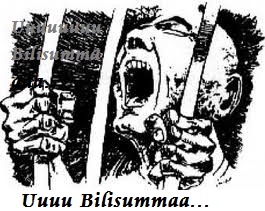
Wallaggaa,Aanaa Hawaa Galaan Keessatti Ayyaana Masqalaan Wal Qabatee FDG Gaggeefameen Oromooti Hidhaman.

Onkoloolessa 18,2013 Dambi Doollo

BilisummaaGabaasaa godina Wallaggaa annaa  Qellem,Hawwaa Galaan irraa boodana nu dhaqabe akka addeessuttti Fulbaana 27,2013 ayyaana masqalaa sababeeffachuun uummanni Oromoo jiraattota Hawaa Galaan ta’an walitti dhufuun sirboota aadaa Oromoo fi  qabsoo dhageessisuudhaan tokkummaa uummataa fi sochii warraaqsaa deemsisaa waan turaniif dabballootaa fi bulchitoota Wayyaanee naannichatti argaman garaa gubaa akka turan gabaafamee jira.
Haalli Oromoon ittiin ayyaana ayyaanefatuu fi sochii guyyaa masqalaa kana irratti taasise milishoota Wayyaanee biratti yakka waan jedhaniif sabboontota Oromoo kanneen ayyaana masqalaa kana irratti argaman walitti qabuudhaan reebichaan ummataq miidhuu fi namoota 40 ta’an gara mana hidhaa Dambidoollootti akka geessan gabaasi naannicha irraa nu dhaqabe addeessa.
Haala kanaan namoonni yerositti mana hidhaatti geeffaman keessaa hammi tokko akeekachiisaan gadhiifamanii kanneen hafan sochii ABO duubaan jirtu isa jedhuun yakkamuun hanga ammaa mana hidhaa diinaa keessatti argamu. Namootni gariin deggertoota ABO jedhamuudhaan hidhamanii jiran keessaa hamma tokko:-
  1. Kabbadaa
  2. Tamam Qana’aa
  3. Eebbisaa Jiraataa
  4. Balachoo Aalamuu
  5. Surraa Sanbatoo
  6. Gadaa Mangistuu
  7. Tolinaa Tafarii
  8. Mangistu Morodaa
  9. Chuuchaa Shifarraa
  10. Taaddasaa Tasammaa
Kanneen jedhaman aanaa Hawaa Galaan irraa mana hidhaa Dambi Doolloo keessatti kan argaman ta’uu Qeerroon godinichaa gabaasa.

Ethiopia: Political Detainees Tortured: Police Abuse Journalists, Opponents to Extract Confessions

(Nairobi) – Ethiopian authorities have subjected political detainees to torture and other ill-treatment at the main detention center in Addis Ababa. The Ethiopian government should take urgent steps to curb illegal practices in the Federal Police Crime Investigation Sector, known as Maekelawi, impartially investigate allegations of abuse, and hold those responsible to account.

The 70-page report, “‘They Want a Confession’: Torture and Ill-Treatment in Ethiopia’s Maekelawi Police Station,” documents serious human rights abuses, unlawful interrogation tactics, and poor detention conditions in Maekelawi since 2010. Those detained in Maekelawi include scores of opposition politicians, journalists, protest organizers, and alleged supporters of ethnic insurgencies. Human Rights Watch interviewed more than 35 former Maekelawi detainees and their relatives who described how officials had denied their basic needs, tortured, and otherwise mistreated them to extract information and confessions, and refused them access to legal counsel and their relatives.

“Ethiopian authorities right in the heart of the capital regularly use abuse to gather information,” said Leslie Lefkow, deputy Africa director. “Beatings, torture, and coerced confessions are no way to deal with journalists or the political opposition.”

Since the disputed elections of 2005, Ethiopia has intensified its clampdown on peaceful dissent. Arbitrary arrest and political prosecutions, including under the country’s restrictive anti-terrorism law, have frequently been used against perceived opponents of the government who have been detained and interrogated at Maekelawi.

Maekelawi officials, primarily police investigators, have used various methods of torture and ill-treatment against those in their custody. Former detainees described to Human Rights Watch being slapped, kicked, and beaten with various objects, including sticks and gun butts, primarily during interrogations. Detainees also described being held in painful stress positions for hours upon end, hung from the wall by their wrists, often while being beaten.

A student from Oromiya described being shackled for several months in solitary confinement: “When I wanted to stand up it was hard: I had to use my head, legs, and the walls to stand up. I was still chained when I was eating. They would chain my hands in front of me while I ate and then chain them behind me again afterward.”

Detention conditions in Maekelawi’s four primary detention blocks are poor but vary considerably. In the worst block, known as “Chalama Bet” (dark house in Amharic), former detainees said their access to daylight and to a toilet were severely restricted, and some were held in solitary confinement. Those in “Tawla Bet” (wooden house) complained of limited access to the courtyard outside their cells and flea infestations. Investigators use access to basic needs and facilities to punish or reward detainees for their compliance with their demands, including by transferring them between blocks. Short of release, many yearn to be transferred to the block known as “Sheraton,” named for the international hotel, where movement is freer.

Detainees held in Chalama Bet and Tawla Bet were routinely denied access to their lawyers and relatives, particularly in the initial phase of detention. Several family members told Human Rights Watch that they had visited Maekelawi daily but that officials denied them access to their detained relative until the lengthy investigation phase was over. The absence of a lawyer during interrogations increases the likelihood of abuse, and limits the chances for documenting abuse and obtaining redress.

“Cutting detainees off from their lawyers and relatives not only heightens the risk of abuse but creates enormous pressure to comply with the investigators’ demands,” Lefkow said. “Those in custody in Maekelawi need lawyers at their interrogations and access to their relatives, and should be promptly charged before a judge.”

Human Rights Watch found that investigators used coercive methods, including beatings and threats of violence, to compel detainees to sign statements and confessions. These statements have sometimes been used to exert pressure on people to work with the authorities after they are released, or used as evidence in court.

Martin Schibbye, a Swedish journalist held in Maekelawi in 2011, described the pressure used to extract confessions: “For most people in Maekelawi, they keep them until they give up and confess, you can spend three weeks with no interviews, it’s just waiting for a confession, it’s all built around confession. Police say it will be sorted in court, but nothing will be sorted out in court.”

Detainees have limited channels for redress for ill-treatment.  Ethiopia’s courts lack independence, particularly in politically sensitive cases. Despite numerous allegations of abuse by defendants, including people held under the anti-terrorism law, the courts have taken inadequate steps to investigate these allegations or to protect defendants complaining of mistreatment from reprisals.

The courts should be more proactive in responding to complaints of mistreatment, but that can happen only if the government allows the courts to act independently and respects their decisions, Human Rights Watch said.

Ethiopia has severely restricted independent human rights investigation and reporting in recent years, hampering monitoring of detention conditions in Maekelawi. The governmental Ethiopian Human Rights Commission has visited Maekelawi three times since 2010 and publicly raised concerns about incommunicado detention. However, former detainees told Human Rights Watch that Maekelawi officials were present during those visits, preventing them from talking with commission members privately, and questioned their impact.

Improved human rights monitoring in Maekelawi and other detention facilities requires revision of two repressive laws, the Charities and Societies Proclamation and the Anti-Terrorism Proclamation. These laws have significantly reduced independent human rights monitoring and removed basic legal safeguards against torture and ill-treatment in detention.

Ethiopia’s constitution and international legal commitments require officials to protect all detainees from mistreatment, and the Ethiopian authorities at all levels have a responsibility both to end abusive practices and to prosecute those responsible. While the Ethiopian government has developed a three-year human rights action plan that acknowledges the need to improve the treatment of detainees, the plan does not address physical abuse and torture; it focuses on capacity building rather than on the concrete political action needed to end the routine abuse.

“More funds and capacity building alone will not end the widespread mistreatment in Maekelawi and other Ethiopian detention centers,” Lefkow said. “Real change demands action from the highest levels of government against all those responsible to root out the underlying culture of impunity.”

=>hrw

East Africa: Ethiopian Dam Plans Spark Regional Tensions

BY REHAB ABD ALMOHSEN, 18 OCTOBER 2013

The project's potential impact on water supplies in Egypt and Sudan is causing friction, finds Rehab Abd Almohsen.
A group of Egyptian academics and experts have declared their opposition to the current plans for the US$4.8 billion Grand Ethiopian Renaissance Dam - on which work has started, and which will be Africa's largest hydroelectric power plant when completed - because they believe it will damage their country.
Egypt's Nile Basin Group was set up to assess the possible threat from the dam, which will lie close to Ethiopia's border with Sudan. Its members warn that the structure could slash the Nile's flow, especially in Egypt and Sudan, which depend on the river's waters.
Haider Yusuf Bakheit, a Sudanese hydrologist, was reported in an article in Infrastructure News as saying that the dam "will hold back nearly one-and-a-half times the average annual flow" of the Blue Nile, one of the Nile's two main tributaries, and "drastically affect the downstream nations' agriculture, electricity and water supply".
"Given the massive size of the dam, it could lose as much as three billion cubic metres of water to evaporation each year," he warned.
Enlarged plans
There was alarm in Egypt when the plan to build the dam was announced in 2011 - with some MPs talking off the record about Egypt's right to retaliate militarily - but much of the opposition now focuses on Ethiopia's decision to increase the size of the reservoir behind the dam.
"The original plan was to create a lake that would store 14 billion cubic metres of water, which is enough to generate electricity, but then the lake's capacity was increased to 74 billion cubic metres," Nader Noureddin, a member of the Nile Basin Group and professor of soil and water resources at Cairo University, tells SciDev.Net. Planned electricity output has also risen, from 5,250 to 6,000 megawatts.
Noureddin says that when Ethiopia decided to increase the height of the primary dam from the 90 metres in the original design to 170 metres, the planners were forced to include a secondary 'saddle dam' to help confine the vast reservoir created by the main dam and prevent stored water from escaping back to the Blue Nile.
"For the first time in history, we find a secondary dam that is four times as large as the original dam, which indicates the aim behind building such a huge dam is not generating electricity, but to use the dam as a way to control Egypt," argues Noureddin. In effect, he says, it would enable Ethiopia to turn off Egypt's water supply.
He favours sticking to the dam's original height and scrapping the idea for the saddle dam.
Rapid water take
Another concern is the speed at which Ethiopia plans to fill the reservoir.
Egyptian experts say that the huge proposed reservoir would normally take up to 20 years to fill, but Ethiopia intends to achieve this in just five years, consuming about a fifth of the Blue Nile's annual flow. That, argues Noureddin, would lead to "catastrophic" impacts on Egypt's agriculture.
Mohamed Mohieddin, a social policy consultant and professor of sociology at Egypt's Menoufia University, and a member of the three-country committee that is negotiating the project's next steps, suggests asking Ethiopia to extend the time allowed to fill the main dam by five or six years.
Through the committee, Egypt would be a partner in the dam's operations and have a say in how the water is released, he tells SciDev.Net.
Tensions between Egypt and Ethiopia, the source of 85 per cent of the Nile's water, rose in June, as soon as Ethiopia started work on diverting some of the river's flow as part of the project.
Aggressive response
Both countries, as well as Sudan, see the project as affecting their national interest, which has sparked tough and aggressive comments from non-scientists.
"Egypt is always sceptical of what Ethiopia might think and do on the Nile," Tatek Kebede, the national coordinator of the Ethiopian National Youth Coalition on Climate Change, tells SciDev.Net.
He says Ethiopia is advancing economically and would not allow Egypt's diplomatic and even military pressures to deter its development ambitions, of which the dam is part.
Ethiopia's national electricity corporation has said potential buyers of electricity from the dam, scheduled for completion in 2018, include Djibouti, Kenya, Somalia, Sudan, Uganda and maybe even Egypt.
An Ethiopian ecologist, who would speak only on condition of anonymity, tells SciDev.Net that, since construction was nearly a quarter complete, "it would be good to find common ground and it would be good for the Egyptian side to deal with their concerns by working closely with the Ethiopian government and maybe even finding a way to benefit from it".
But Noureddin blames the Ethiopian government for "raising the hope of its people to a very high level", making it hard to compromise for fear of appearing weak.
Earlier this month, Ethiopia's prime minister, Hailemariam Desalegn, attempted to defuse tensions by emphasising the importance of good relations with Egypt. He described the dam as a common resource that will benefit all three countries.
But with passions still running high, Ana Elisa Cascão, a programme manager at policy organisation the Stockholm International Water Institute, believes cooperation is the only solution.
"The only hope for Egypt and Sudan is to have a share in the dam by funding it, and to cooperate with Ethiopia to jointly manage the dam," she tells SciDev.Net.
The next step in this unfolding story is a meeting of the Ethiopia-Sudan-Egypt dam committee. But even that is caught up in national and regional politics: it was due to meet on 20 October but now - due to recent rioting in Sudan over the lifting of fuel subsidies - all that has been agreed is that it will take place at some point in the next few weeks.
Rehab Abd Almohsen currently holds an IDRC/SciDev.Net science journalism internship award.