Wednesday, September 24, 2014

FAJ Calls on Ethiopia to Free Journalists Jailed

The Federation of African Journalists (FAJ) has today called on the government of Ethiopia to free all journalists in jail and to create the conditions for tens of journalists in exile to return home and work for their country’s development.  

“We are very concerned about persistent reports of press freedom violations in Ethiopia and the increasing number of journalists in jail and in exile” said Mohamed Garba, President of the Federation of African Journalists (FAJ). “I join my voice to call on the Ethiopian Government to engage the media through genuine dialogue and self-regulation”

The Ethiopian Government Minister for Communication Affairs, Mr. Redwan Hussien on Thursday 18 September received a three-man delegation comprising Muheldin Titawi, President of the Eastern Africa Journalists Association (EAJA), Alexandre Niyungeko, Secretary General of EAJA, and the Africa Director of the International Federation of Journalists (IFJ) Gabriel Baglo. The delegation paid a courtesy visit to Minister Hussien on the sidelines of a workshop on investigative journalism and corruption reporting for a group of 20 Ethiopian Journalists co-organized by the Ethiopian National Journalists Union (ENJU) and Eastern Africa Journalists Association (EAJA) in Addis Ababa.

Addressing the delegation, the Minister said Ethiopia is committed to ensuring freedom of expression, and expressed Ethiopia's support to bring the issue of journalists' safety in the upcoming Summit of African Union Heads of State. The minister briefed the delegation about the recent court ruling that closed six publications which resulted in 14 journalists going into exile. The Minister said that the journalists had no justification to run away as they were not charged. He reiterated the commitment of the Ethiopian government to respect the diversity of thoughts as long as ethical journalism is exercised. He said Ethiopia's democracy is based on accepting and acknowledging ethnic, religious and ideological differences and this is manifested in the Constitution which everyone should uphold.
The delegation reminded the Minister that in the region, Ethiopia and Eritrea have produced more journalists in jail and in exile, and that this is a bad image for the country that hosts the African Union Commission. The delegation called on the Ethiopian Government to release all journalists in jail and to create the conditions for the return of all journalists in exile. The delegation expressed the commitment of African journalists’ organisations to work with the Ethiopian government and with journalists for the creation and support for ethical media reporting through self-regulation.
 "We are here to support African journalism with African values; we are ready to give any support to Ethiopian journalists in the light of African shared values and African Union instruments such as the Declaration of Principles of Freedom of Expression in Africa, and the African Charter on Democracy, Election and Governance” said the delegation.


=>ifj

Tuesday, September 23, 2014

We don’t expect a free and fair election from TPLF regime on upcoming general election in Ethiopia

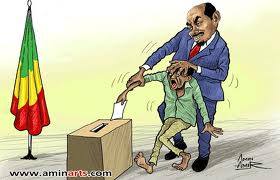
Cartoonist depiction of Ethiopian election         All human beings are born free and equal in dignity and rights. If not all, most of the people in every country have heard of what human right is about. According to the Universal declaration of human rights, no one or a group shall be subjected to torture, cruel, inhuman or degrading conditions, regardless of race, colour, sex, religion, political opinions or language, which means
-all are equal before the law and have equal protection of the law.
-everyone has the right to have their case considered by an impartial tribunal.
-citizens have the right to express their opinion freely, the right to freedom of peaceful assembly and association are inalienable basic human rights.
-everyone must abide by the moral requirements, laws and regulations. In a democratic country people’s will also shall be expressed through elections and the government would not interfere with ballot box as the popularity of the party’s platform will be decided only by a secret ballot and the ballot box result.
In Ethiopia what has been mentioned above is not totally exercised mainly due to the fact that the TPLF/EPRDF regime has not departed from using excessive force, and the rule of law has been violated by the regime everywhere in the country, particularly in Oromia. Nelson Mandela once said,
“To deny people their human rights is to challenge their very humanity. To impose on them a wretched life of hunger and deprivation is to dehumanise them.”
One would simply wish Mandela’s words are observed and practiced carefully by the TPLF regime and its members who have been dehumanizing, subjugating and killing innocent Oromo people with the sole purpose of controlling their day-to-day life and their natural resources.
Since Tigray Peoples Liberation Front,(TPLF) has come to power, they are recognised more for behaving as if Oromia and other regions in Ethiopia are their private property than for any other thing as they also seem to think as if political power, that has been used by TPLF/EPRDF regime and its members to subjugate, repress, torture, imprison, impoverish, exploit and kill innocent people is something they inherited from their Tigrian ancestors. I believe except TPLF/EPRDF regime no one or group ever considered the country and political power as its private property in the history of our country.The country and its political power should belong to the public at large not to the gun-toting few tribal cabals.
When I studied and learned what TPLF has done since they overtook political power in our country, it sounded like from the beginning they came to power to have everything under their control and lead the people into abject poverty, as a result of which obviously, citizens became powerless and forced into submission to TPLF regime in order to get basic necessity for survival while TPLF regime members & few Tigran loyalists enjoy a luxurious life style.
The TPLF/EPRDF regime members and loyalists have gained wealth in many fronts, corruption being the leading means besides the aid money diverted into the pocket of the few and the purchase of weapons used to suppress the oppressed people under their misrule. While aid money for a poor contry like ours is welcome , the donor country should have used their power to hold TPLF thugs to account for misusing the dole. For example when Juventus football club was found guilty of match fixing corruption, it was relegated to the second division and also hit by many other punishments. Likewise, there is a moral duty to hold dictatorial regimes like TPLF/EPRDF who caused people to suffer and play games with their life to account unless the West and America is determined to support the criminal government of Ethiopia instead of the people.
As we know, fake national elections took place in 1992, 1994, 1995, 2000, 2005 and 2010 in Ethiopia. In all these fake elections, the people who could have played the decisive part in those general elections have been excluded from the processes of decision making positions. Because of this the Ethiopian government failed to secure domestic legitimacy from the countries citizens except from western countries that recognized them as a true winner of all those elections by ignoring the principles of a true democracy and respect for human rights.
Especially when I remembered the election that took place for the last two decades in Ethiopia, I always feel pain for many reasons:-
- First, when I remember those who lost their lives after they have been shot to death by TPLF regime security forces for demaning the result of the said to be free and fair election.
-Secondly, when I remember how TPLF regime ignored the will of the people and declared themselves as the genuine winners of the election contrary to the reality.
- Thirdly, when I remember how TPLF regime put Oromo activists and others in prison and torture chambers, how they brutally killed many Oromo students in different incidents while the students peacefully protested for justice and freedom.
- Fourthly when I think about Western powers who ignored the will of our people and continued supporting the dictator regime in Ethiopia.
-Fifthly when I think about the way TPLF regime and its members robbed the natural resources of Oromia and other regions in Ethiopia and harassed and killed the innocent people by the weapons that has been bought with the natural resources it has robbed from the country.
The TPLF/EPRDF regime has claimed all those fake elections as true winner in Oromia and other regions in Ethiopia and managed to carry on with their repressive political system, with the help of purpose-designed fake organizations like the Oromo Peoples Democratic Organization (OPDO), which is a collection of elements of some Oromo natives and individuals of other tribes who settled and lived in Oromia and could speak Oromiffa/ Oromo language. These TPLF lackeys have no any concern and affection for Oromo people whom they have betrayed and exchanged for personal wealth and achievement of low level political positions. These organizations enable TPLF thugs to persecute, torture, and kill Oromo people and plunder the natural resources of Oromia in order to enrich the TPLF/EPRDF regime members.
Apparently, OPDO and other organizations are a key players in keeping woyane in power by being a replacement to Oromo Liberation Front(OLF) in Oromia which is the richest and most populous regionl state. Obviously, the TPLF government always critics of OLF and caused sufferings OLF members and supporters, not because OLF have done something wrong, but TPLF is aware of that if OLF get an opportunity to represent Oromo people in national elections in Ethiopia,TPLF has no chance of winning the elections by any means, because OLF is the organization that determined to bring a change in Oromia. In addition to this, the OPDOs help,TPLF to keep OLF at bay since it is the organization that is struggling to bring a true democracy, political and socio-economic change, justice and freedom in Oromia in particular and Ethiopia in general.
We have seen Woyanes having been in power for so long but we have not seen any change in Ethiopia either in politics, economy, human rights, freedom of expression which is the pillar of a democratic and free society that is unnatural to the TPLF/EPRDF regime. The regime has totally failed to care about the society. As associate professor of political science and international relations at Addis Ababa University, Dr. Merera Gudina said Woyane politics is one step forward and two steps backward and the same professor also said when he presented about Ethiopian national election, if a team enters into a football match with its own referee, it is not difficult to know which team will win the game. Generally, Ethiopian politics has continued being repressive in its manner and the election process as bad as it was in the Derg era.
The ruling party has already started, as it used to do in the past through its security forces and cadres, intimidating, arresting and torturing, opposition leaders and their members and supporters, journalists and bloggers before elections, this is due to the fact that they want to redirect the citizen’s thought and attention, hence it would be naive to expect a free and fair election in that country, while TPLF is in charge of political power. As it has been many times, election in Ethiopia is planned and designed in advance including pre-registration with intimidation and ballot stuffing for a biased and favorable result. This is due to the fact that the country’s security force composition and the Ethiopian television which could reasonably be termed as TPLF TV are all in favour of the ruling party.
This picture proved for us how the government security forces are beaten those who protested(Women and youth) against vote rigging.
The Western countries also seem to be supporting TPLF/EPRDF unconditionally. What is most disheartening unfortunate is the fact that a country like America that claims to advocate democracy and human rights dedicates itself to supporting, recognizing, inviting and welcoming Ethiopian political leaders to a very important meetings for Africa and America while they know these leaders torture, abuse and kill the innocent people in Ethiopia, particularly in Oromia. Because of these facts and factors, we cannot expect a free and fair election from TPLF/EPRDF regime on the upcoming general election.
The other reason is the TPLF/EPRDF regime and their members also proved how any election process and its result under their rule would always be a fake exercise when they claimed that they won election by 99.6% in the general election in 2010. Though it was a shameful event in the history of elections anywhere in the world, the TPLF is a careless organization that can do an immoral thing they could afford to retain political power. As we know they did not give even a little space and an opportunity for opposition parties to come out and propagate their political programs to the public in all elections that took place while TPLF was in power.
The reason why the opposition parties did/do not get chance is because national TV remains controlled by TPLF/EPRDF, on the other hand if opposition leaders and their members use social media to reach their supporters, TPLF would accuse them of treason that can possibly subject them to brutal torture and possible death. Besides this, the people have no right of protesting if and when their vote gets stolen.
I conclude my article by saying that, if we are really to save our country and avoid an unprecedented crisis, all true citizens of Ethiopia in general and the Oromo people in particular need to join hands and stand shoulder-to-shoulder to bring a true democracy and unlimitted freedom of speech, in order to enable citizens to express their dissatisfaction with their government’s performance and chart their own destiny without a brutal government lording on their life only to hamper the free exercise of their God given right.
Alemu Hurissa

Hirbuu Dhiigaan Eegalame

Jiituu lammii, Ful. 23, 2014
Halkan dhawaata bari’a. Hanga obsaa fi murannoon itti deeman mallattoo barii lafaa eeru arguu fi dhaga’uu jalqabu. Hangasitti garuu cichaa fi murannoo gaafata. Seenaa qabsoo bilisummaa Afrikaa keessatti Hanga xumura waraana Addunyaa 2ffaa (WWII)tti dukkanni gabrummaa dachee Afrikaa dhuunfate tasuma waan bari’u hin fakkaatu ture. Haa ta’uutii garuu taateen seenaa kana jijjiiru guyyaa isaa eegee  dhalachuu hin oolle. Innis sochii barattoota Afrikaa ti.
Barri 1935 – 1960 bara sochiin barattoota Africa jabinaa fi heddumminaan itti mul’atee dha. Baay’inni dhaabbilee barnootaa dachee Afrikaarratti mul’achuun,  lakkofsi ilmaan Afrikaa mana barnootaa seenan akka dabalu taasise. Lakkoofsi barattoota ilmaan Afrikaa biyya keessaa fi alaatti dabalaa deemuun dammaqiinsa siyaasaa fi hadheeffannoo gabrummaarratti isaan qaban jabeessuu eegale. Dammaqinsaaa fi hadheeffannoo kana keessaa warraaqsi dammaqinsa hawaasaa uumu dhalate. Dhaloota warraaqsa kanaatu dukkana gabrummaa dachii Afrikaa dhuunfatetti daangaa kaa’uun waldhaansoo haaraaf karaa saaqe. Waldhaansoo Diddaa Gabrummaa!
Sochiin jalqabarratti seenaa fi aadaa sabaa dhaadhessuutti fuulleffate, dhawaata bifa fincilaa fi diddaatti geeddaramuun gaaffii bilisummaa kaase. Warraaqsi kun hidda jabeeffatee dhaloota jaarmiyaalee bilisummaaf karra saaqe. Hoogganoota siyaasaa jajjaboo magarse. Tarsimoo fi tooftaa bilisummaa biyyaa dhugoomsan akeekuun qabsoo tarkaanfachiise. Akkaataa kanaan biyyoonni Afrikaa: Gaanaa (1957), Nayijeeriyaa (1960), Seeraliyoon (1961), Keenyaa (1963), Ugandaa (1962), Tanzaniyaa (1961), Tunisiyaa (1956) fi kanneen biroo hedduun Gabrummaa ofirraa cabsuu danda’an.
Akkuma seenaa biyyoota Afrikaa kanneenii faana seenaa Qabsoon saba Oromoo keessa darbe yoo yaadanne, sochiin barattoota Oromoo seenaa fakkaataa qaba. Jaarmiyaa Oromoo walaba (independent Oromo Organization) ijaaruu dabalatee diddaa Oromoon bifa faffaca’een gabroonfattootarrattii geggeesssu bifa qindoome akka qabaatu gochuuf  barattoonni Oromoo seenaa seenaan hin daganne kaayaniiru.  Aadaa, seenaa fi walumaa galatti eenyummaa Oromoo ifa baasuun Oromoo dammaqsaniiru. Akeeka jabaa fi tarsiimoo fulla’aa kaa’uun qabsoo Bilisummaa Oromootti bu’uura jabaa tolchaniiru.
Qabsoon Oromoo haala ulfaataa fi qormaata jajjabaa keessa bahee dhimmoota waan hin danda’amne fakkaatan danuurra aanee isa kaleessa fageenyatti ilaalamee “kuunno ti!” jedhamaa ture har’a dhiyeenyatti “kunoo ti!” akka jennuuf itti wareegamaniiru. Barattoonnii fi Barsiisonni Oromoo carraa dhiphoo bara seenaa qabsoo Oromoo keessatti bara ce’umsaa ykn ‘Charter’ jedhamu keessa argamtetti haajamuun akeeka bilisummaa Oromoo ABOn barsiise saffisaan simataniiru. Akeekni kun hundee jabaa horatee qe’ee Oromoo keessatti akka dagaagu itti cichaniiru. Akeekni Walabummaa Oromiyaa fi Bilisummaa Oromoo Onnee Oromoo keessatti akka biqilu gatii jabaa baasaniiru.  Ifaan  bilisummaa gaafas qabate har’a balbala Oromoo hundarraa ifa.  Kanatu hidhata qabsoo Oromoo fi sochii brattoota Oromoo gidduu jiru  jabeessa. Kanatu diina yaaddessa.
Har’a sochii barattoota Oromoo addunyaatu beeka. Jaarmiyaaleen mirga dhala namaaf dubbatanii fi midiyaaleen addunyaallee sochii kana haalaan dhaggeeffatu. Tokkummaa Oromoo jabeessuu fi qabsoo bilisummaa Oromoo fuulduratti furgaasuu bira darbee  wiirtuu siyaasa Impaayerattii sochoosu danda’eera. Kanaaf jarmayaaleen siyaasaa Impaayerattii maqaa dhahatan hedduun miiraa fi akeeka adda addaatiin sochii kana xiyyeeffannoon hordofuuf dirqamaniiru. Sochiin kun seenaa sochii barattoota Afrikaa keessattillee yoo ta’e sadarkaa dursaatti akka yaadatamu boru seenaan dhugaa bahuuf dirqama.
Kuni yaadannoo seenaa kaleessaa qofa miti. Dhugaa har’aa fi ta’innaa boruullee of keessaa qaba.Qabsoon Oromoo qabsoo si’aawaa (active struggle) shaffisaan of fuulduratti ce’aa jiru ta’eera. Duubbee isaa Qeerroo fi Qarree barattoota Oromoo miliyoonatti lakkaawamantu hiriire. Ka’umsaa fi galma isaanii beeku. Jalqabaa fi xumura imala isaanii yaadatu. Kayyoo fi karoora ofii qabu. Isaan masakamu. Kanaaf Qabsoon kun dhiigaa fi lafee Qeerroo fi Qarree Oromoorraa ijaarame. Hidhata addaa walirraa qabu. Hammeenyii fi gidiraan bifa kamiituu walirraa gargar baasuu dadhabe. Sobaa fi sossobbaan hin dagachiisu. Shiraa fi gooliin hin gufachiisu. Kumoota ajjeesanii kumaatama yoo hidhan, akeekaka sabaa kaayyoo ganamaa  galmaan gahuuf dacha dachaatu bakka bu’a. Inni dhufaa jiru isa argaa jirru caala. Hirbuun dhiigaan eegalame bilisummaan xumurama.
Gadaan Gadaa Bilisummaa haata’u!!
Ani Jiituu Lammii ti!

Monday, September 22, 2014

Borana Calender

Views and news from the 4th New World Summit of Stateless States

Dr. Shigut Geleta speaks atmThe New World Summit-Brussels Stateless State
Dr. Shigut Geleta addresses The New World Summit of Stateless State
The New World Summit of Stateless State was held from September 19-21 at Royal Flemish Theatre (KVS) in Brussels, Belgium. Twenty stateless political organisations have been participated on this summit. The Summit was divided in to five sessions. These are: Oppressive State, Progressive state, Global state, New States and Stateless State. Dr. Shigut Geleta has presented on the Oromo issues on the first session and his paper addressed how successive Ethiopian regimes orchestrated the notion of self-determination and attempted to blackmail genuine Oromo Liberation struggle.
shigut4 shigut3 shigut2 shigut1
OPPRESSIVE STATE

A Criminal State: The Blacklisting of the Oromo Liberation Struggle for Freedom and Democracy

The Oromo Liberation Front (OLF) is a political and militant organization that fights for the self-determination of the Oromo people against Ethiopian rule. As a result of the struggle that began after the Ethiopian colonization of Oromia in the late 19th century, the OLF was formed as a secular, military organization that ousted Emperor Haile Selassie during the Marxist-Leninist revolution in 1974. The OLF has also fought the subsequent Derg military regime (1974-1991) in coalition with other military nationalist organizations, such as the Ogaden National Liberation Front (ONLF), the Eritrean People’s Liberation Front (EPLF) and the Tigrayan People’s Liberation Front (TPLF). When the thirty-year civil war finally led to the toppling of the Derg regime in 1991 and the independence of Eritrea, the OLF participated in the mainly TPLF’s dominated Transitional Government of Ethiopia. As the TPLF consolidated its grip on power and continued to negate the political autonomy of the Oromo, the OLF left the Transitional Government in June 1992, which leads to a violent backlash against the Oromo population. Currently, despite being a democracy in theory, both the military regime as well as the political and economical sphere is dominated by the Tigrayan minority. As a consequence, other oppressed ethnicities such as the Ogaden and the Oromo continue their military and political struggle for self-determination. Following Ethiopia’s adoption of the restrictive Anti-Terrorism Proclamation in 2009, the OLF was blacklisted as a terrorist organization along with the ONLF and the Ginbot 7 movement, which lead to large-scale arrests and prosecution of prominent members of these groups, including parliament members and candidates.

This lecture addressed the manner in which blacklisting a political movement as ‘terrorist’ functions as an ideological cover-up of the enforced administrative construct of the Ethiopian state. Apart from the Oromo, who represent the largest ethnic group in the country, many other peoples struggle for independence from the contested state. At what level can we argue that the state of Ethiopia even exists, when its main legitimacy seems to be based on its capacity to suppress the very political majorities that constitute it? The blacklisting of a people’s history thus becomes a way of evading confrontation with the criminal dimensions of the state itself.

Dr. Shigut Geleta is Head of the Oromo Liberation Front’s (OLF) Diplomatic Division.


=>ayyaantuu

Sunday, September 21, 2014

Moving Forward: Sacrificing Time for Oromo Identity

Daandii Ragabaa | 
Irreechaa is a national Thanksgiving Day celebration that repeats once or twice in a year and involves special activities or amusements.

For Oromo, Irreechaa is a good way to pass on cultural knowledge and it helps to build pride in young people and helps them to have confidence when talking with others about their culture and identity. Hence, celebrating Irreechaa means having the confidence that comes from knowing the Oromos have something unique and vital values in their long journey.
The 2014 Irreechaa Birraa festival is one of the main celebration in every year at the beginning of Birraa (the sunny new season after the dark, rainy winter season) throughout Oromia and around the world where Diaspora Oromos live on the theme of “Moving Forward: Sacrificing Time for Oromo Identity”.

A Bicameral “Caffee” (Two-House) Government System in Oromia

By “Reinvent Ethiopia”*
BicameralismOromiyaa20142
Bicameralism (two-house government) is a classical standard in democracy and governance. Many governments, both of the developed and the underdeveloped countries, employ it. In fact, as we will see later on, in some countries, some federal states have two-house governments. Bicameralism is a mode of government where the legislative power is shared between two mutually independent houses (chambers, or “caffee” in Afan Oromo). The power of the two houses can be equal as in the U.S.A., or in some cases, the lower house has more power as in the UK.

In the United Kingdom, the House of Commons (lower house) and the House of Lords (upper house) both draft laws, scrutinize government policies and debate legislation. All laws must be approved by both houses, except laws related to tax and finance, for which the the House of Commons can act solely. The House of Lords is considered the voice and legacy of the Church of England and the Monarchy. Its members are appointed by the Queen with advice from the Prime Minister. All Lords Spiritual of the House of Lords are members because of their ecclesiastical role. The members of the House of Commons, on the other hand, are elected through public vote.

Recently, many Oromo scholars, politicians in exile, and even those in Oromia, online activists, and Oromo rights advocates are engaged in a campaign to raise awareness about the revival and renaissance of the Oromo Gadaa System. For instance, the Oromo Studies Association (OSA) has brought retired and current Abbaa Gadaa’s to tour the Diaspora to teach and raise awareness about the Gadaa System.

The two-house system of the UK has not merely emerged from the need for checks-and-balances between the two chambers of the legislature, but also due to the need to preserve the rich British history and politics – which often has to do with the Monarchy and the Church of England. Anyone even with little knowledge of Oromo history would understand the immense role of the Gadaa system and the Qaalluu institution play in Oromo polity of yesterday, and even today. The Gadaa System was the reason why our ancestral Oromos defeated their enemies, and controlled and expanded their territories successfully. The Gadaa System gave the much needed structure of governance – where distinct roles were assigned for efficient warfare and livelihoods. On the other hand, the Qaalluu institution enforced peace (Nagaa Oromoo) with neighbors, and among Oromo gosa’s (clans) through spiritual teachings.

The Qaalluu institution and the Gadaa System, just like the British Church of England and the Monarchy, require representation and preservation. Oromo are largely followers of Christianity and Islam; nevertheless, the Oromo traditional/indigenous religion (Waaqeffannaa) has become important because of its Oromo identity markers. Occasions, such as Irreecha, attract millions of people from all over Oromia and the Diaspora. From the debate whether Irreecha is a cultural ceremony or a religious practice, it is evident that the roots of the Oromo culture, the parts which have not been influenced by the Abrahamic religions, have to do with the Qaalluu institution and Waaqeffannaa. Therefore, regardless of having fewer followers, the Waaqeffannaa religion has the biggest responsibility to preserve some aspects of the Oromo identity. This is very much true, given the fact that both Christianity and Islam systematically impose or carve their own identities among Oromos, and attempts to make them receptive to Oromummaa has been a failure thus far.

Unfortunately, the Ethiopian Constitution does not give a particular recognition to either of the Gadaa System or the Oromo traditional religion. Ethiopia’s House of Federation somehow attempts to represent some aspects of ethnic identities and diversity, but it miserably fails to even attempt to incorporate some aspects of Gadaa into functional government structures. Note that Gadaa is not just to Oromos – many nations in Ethiopia, such as the Sidama, Konso, Burji, Gedeo, Hadiya, Kambaata and others, have Gadaa-like self-administration. In a country of over 80 ethnic groups, it can be difficult to just incorporate the indigenous egalitarian democratic system, like Gadaa, into functional government structures – leaving behind, for example, the entire monarchical system of the Semitic-speaking Amharas and Tigreans. Yet again, one should understand that there is nothing peculiarly indigenous in the imperial realms of Menelik, Yohanes or Haile-Selassie, and in the elevated role of the Ethiopian Orthodox Church – this increasingly assimilative approach to forming the Ethiopian empire was copied from European monarchies, often with the help of European advisors to these kings. So, which one is worth preserving? The indigenous Gadaa System or a copied repressive imperial system? I ask this question assuming the Amharas and Tigreans would aspire to make the imperial or monarchical system to be represented and have power in their own upper houses.

Although not always the case, a federal State can opt for two-house government structure. In India, that is from which the Ethiopian constitution was largely modeled, six States follow the two-house system. These are Andhra Pradesh, Telangana, Bihar, Jammu-Kashmir, Karnataka, Maharashtra and Uttar Pradesh. Other countries, such as the U.S.A., Australia, Germany, Russia and Argentina, also have many States that employ the bicameral legislative system. These federal States employ bicameral legislature mainly for three reasons: (1) to efficiently solve conflicts within the State, between the State and the federal government, and between two or more States; (2) to draft and pass legislation, and scrutinize government policies; and (3) to provide a forum of independent expertise.
No federal State in Ethiopia has the two-house government. The Ethiopian Constitution grants the full right to the respective State to draft or amend its own constitution and manage its own affair, such as administration (Article 50(5)). Other powers of the States of the federation are given in Article 51 of the federal Constitution. Therefore, there should be no conflict with the supreme law the land if a State opts for the two-house government.

Article 39 (2-6) of the Constitution of Oromia stipulates the right of the federal State to self-administer and determine its own mode of government. Caffee or the Oromia Parliament holds the highest power in the state. This is the only house in the state. The Constitution talks much about the powers, which the State has to develop the culture, language and history of the Oromo people, but not much is done in reality. Given the large swath of territory of Oromia, its immense economic power and the frequent conflicts of interest that State has with the federal government, and the need to incorporate Gadaa democracy into functional government structures, it is pertinent to amend the Constitution and establish an upper house of the State government.

Fortunately, works have been done in the areas of revival of the Gadaa System, and establishing the upper house would not be something to be done from scratch. The recently established Gadaa Council (Gumii Gadaa) consists Abbaa Gadaa’s from all over Oromia and five Odaa’s: Odaa Roba, Odaa Bultum, Odaa Bisil, Odaa Buluq and Odaa Nabee (Hararghe, Arsi, Macca, Guji, Borana, Karrayyu, Tulama, and Wallo). As Abbaa Gadaa Bayyanaa Sanbatoo indicated in his recent speech at the OSA-organized event in the U.S.A., the Council has about 125 seats. These seats are not only left for Abbooti Gadaa. Scholars and other appointed individuals can be part of it. It follows the three major ways through which individuals can become members of upper house: appointments, and indirect or direct elections. In some countries, individuals can be members of upper house because of inheritance, but the Gadaa System does not entertain such membership. Abbaa Gadaa Bayyanaa Sanbatoo has also indicated many seats are reserved for Haadha Siiqqee’s. By virtue of being part of the Gadaa System, the Oromo traditional religion or Waaqeffannaa should also be represented in the house.

For many reasons mentioned above, the State of Oromia should revise its Constitution and follow the two-house government: where Caffee has the political power while Gumii Gadaa (simply Gumii) can take the model of House of Lords in Britain. The independent Gumii Gadaa has the power to (1) challenge the government and question policies and strategies; (2) scrutinize their implementation; (3) recommend policy objectives; (4) enact laws related to culture, language and history of the Oromo people; and (5) conduct investigations or establish independent inquiry commissions in cases of conflicts, high profile corruptions and mismanagement.

* The writer, “Reinvent Ethiopia,” can be reached at reinvetethiopia@gmail.com


=>gadaa
Gadaa.com